
Bulk Power Banks: Lot Inspection Before the Recall List
Plan a bulk power bank lot inspection: match model documents, compare capacity ratings, select samples and record output checks before deciding on the lot.
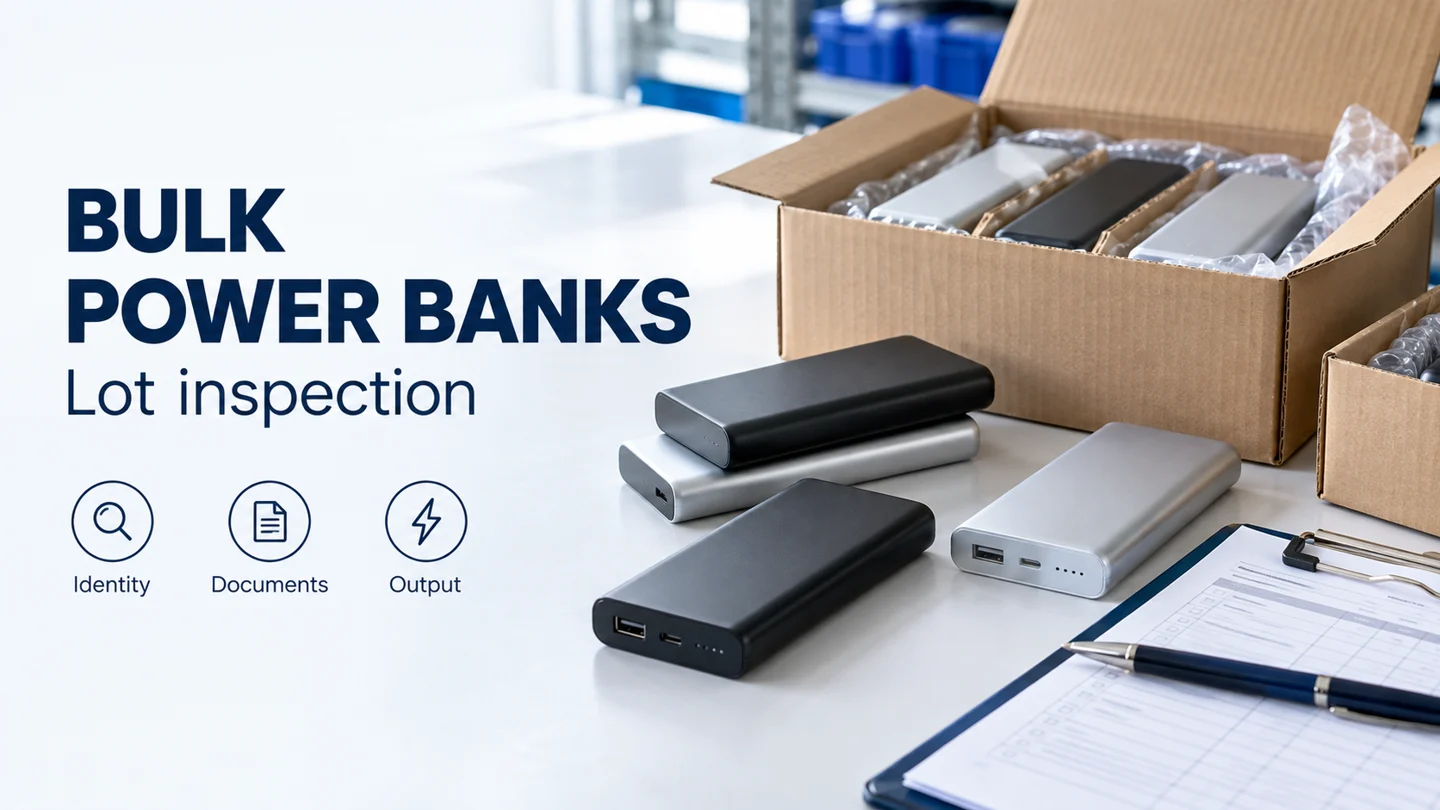
For bulk power banks, start the lot inspection with model identity, applicable documents and an agreed sampling decision. Then record the output check against the named model’s rating and test conditions before deciding whether to release, hold or reject the order.
Use this receiving workflow alongside our Charging & Power guide. For a specific recall enquiry, continue to the power-bank recall model and serial check.
Match the delivered model to its paperwork
The model number links a battery or product to a test summary.
Start a receiving record with the order reference, carton identifiers, supplier, printed model and available serial or batch marks. Photograph the delivered label and ask for the applicable lithium battery test summary. Keep the model match visible beside the inspection result.
The summary identifies the cell or battery model, or alternatively the product model when the summary is established for a product containing a cell or battery.
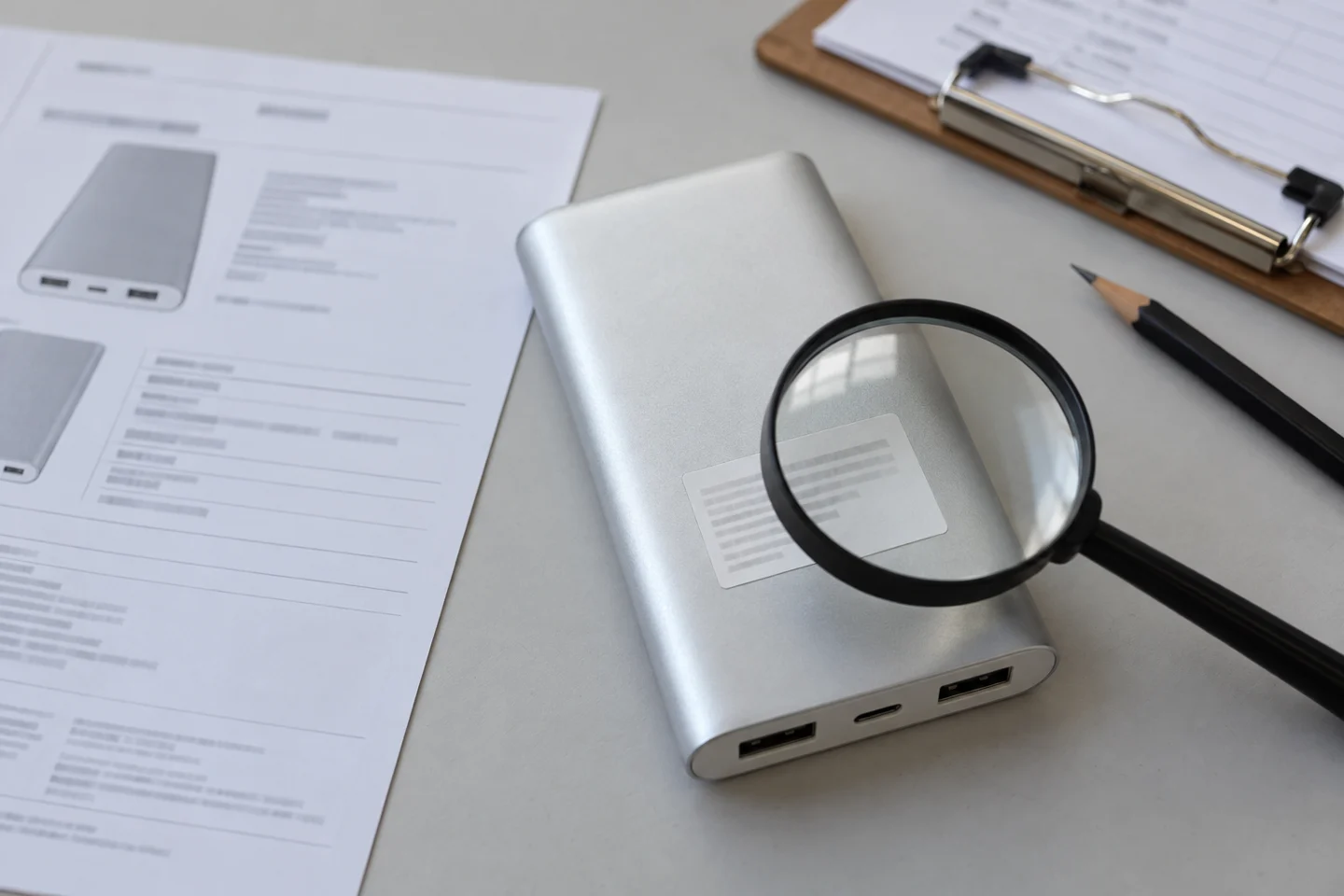
Use the following document checks when assembling the order file. PHMSA’s test-summary guidance specifies these fields:
-
The test summary includes the name of the cell, battery or product manufacturer, as applicable.
-
The test summary includes a unique test report identification number.
-
The test summary includes the date of the test report.
-
Manufacturer contact information includes address, telephone number, email address and website.
-
Test-laboratory information includes its name, address, telephone number, email address and website.
-
The test-summary description includes the mass of the cell or battery.
-
The test-summary description includes watt-hour rating or lithium content.
-
The test-summary description includes a physical description of the cell or battery.
-
The test summary includes the list of tests conducted and their pass/fail results.
-
The summary identifies the revised edition of the Manual of Tests and Criteria used and any amendments.
-
The test summary includes the name and title of a responsible person as an indication of validity.
A single document may cover multiple batteries, manufacturers or products if all required information is included. A summary covering multiple products must have the test report number and date of test for each listed cell, battery or product.
For a summary listing several products, mark the entry that corresponds to the delivered model. Record any unresolved match as a hold item for the order review.
Read cell capacity and output capacity separately
Watt-hour energy equals ampere-hour capacity multiplied by voltage.
Keep the cell rating and the output rating in separate fields. Include the voltage and the stated output condition when transcribing either rating.
PLM13ZM uses a lithium polymer battery.
For that Xiaomi model, the manual gives the following ratings:
Scroll horizontally to see all columns.
| Rating in the manual | Published value and condition |
|---|---|
| Cell energy | Cell capacity is 37 Wh. |
| Cell charge capacity | Cell capacity is 10000 mAh at 3.7 V. |
| Rated output capacity | Rated capacity is 5500 mAh at 5.1 V/2.6 A. |
Use the output-rated condition as the comparison entry in the receiving worksheet; retain the cell specification beside it. Label the supplier’s rating and the measured result separately.
Power-bank circuits consume energy and dissipate energy as heat.
Set the sampling decision before opening cartons
A lot acceptance sampling plan combines a sampling scheme with decision rules. A lot-acceptance sample should be picked at random from the lot.
Agree the lot definition, inspection unit, selection method, sample size, defect categories and acceptance rule before recording results. Include the agreed rule in the receiving record.
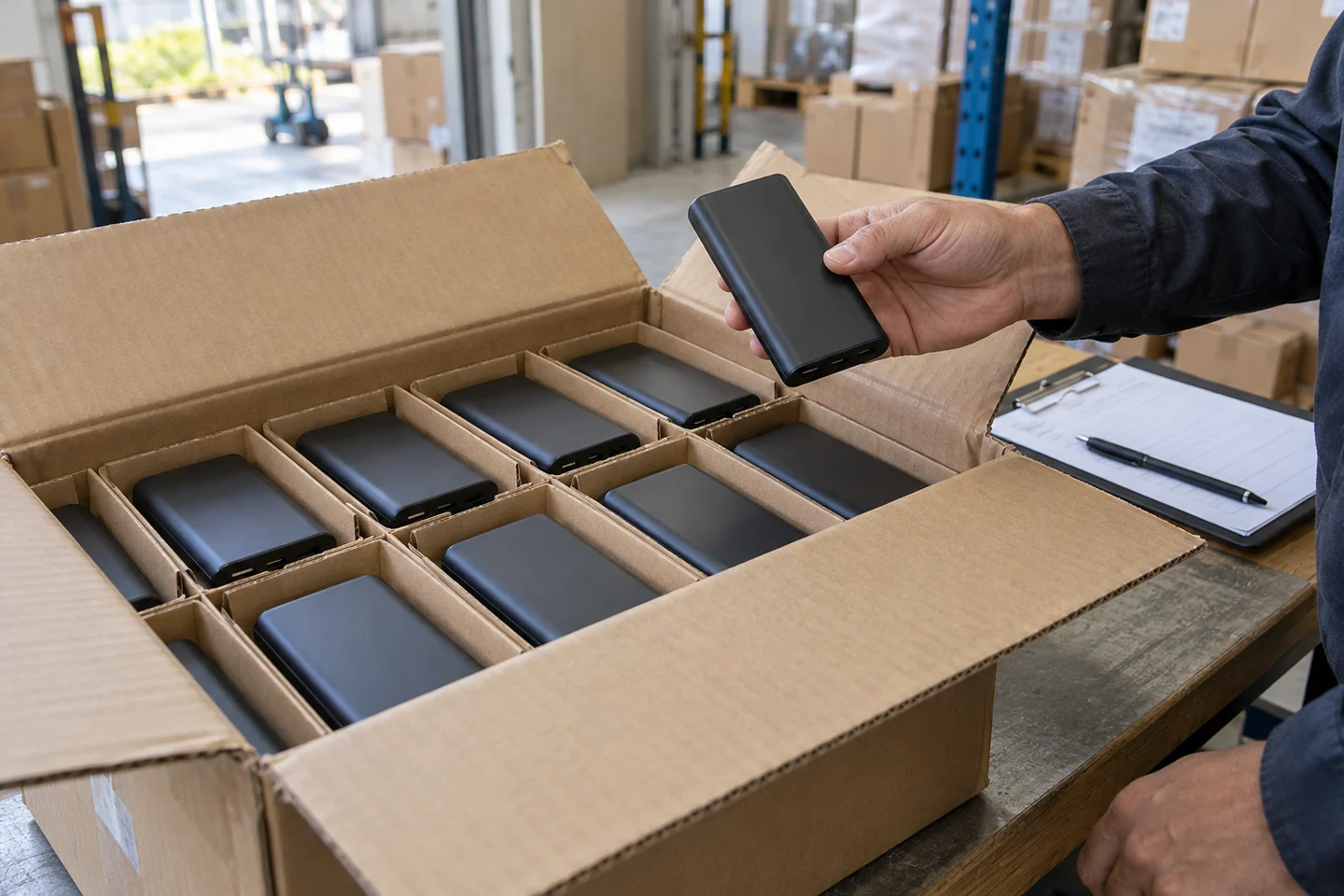
The main purpose of acceptance sampling is deciding whether the lot is likely acceptable, not estimating its quality.
In a single sampling plan, the lot is rejected if sample defectives exceed the acceptance number; otherwise it is accepted.
A double-sampling plan combines results of both samples when the first outcome requires a second sample.
Keep the original findings attached to the lot decision. If the plan calls for further sampling, record it as a continuation of that plan.
Inspect the casing before preparing the output check
Review the exact model’s handling instructions before connecting the sample. For the Xiaomi model above, the manual gives these precautions:
-
Stop using the power bank immediately if it becomes swollen, deformed or starts to leak.
-
Do not open the power bank casing, to avoid battery damage or safety hazards.
-
Use an appropriate charger and USB cable when charging the power bank or using it to charge devices.
-
Do not leave the power bank unattended while charging.
Add an exterior-condition field to the receiving worksheet. Record the observation and the action taken before moving to the electrical-check record.
Record delivered output and the measurement setup
A USB power meter records the total mAh and Wh delivered between the power bank and the connected device.
Use this sequence from Anker’s output-capacity measurement guidance:
-
Fully charge the power bank before the output-capacity measurement.
-
Plug the USB power meter into the power bank output port.
-
Connect a load to the USB meter.
-
Allow full discharge while the meter records cumulative output.
-
Read total recorded mAh and Wh when the power bank switches off.
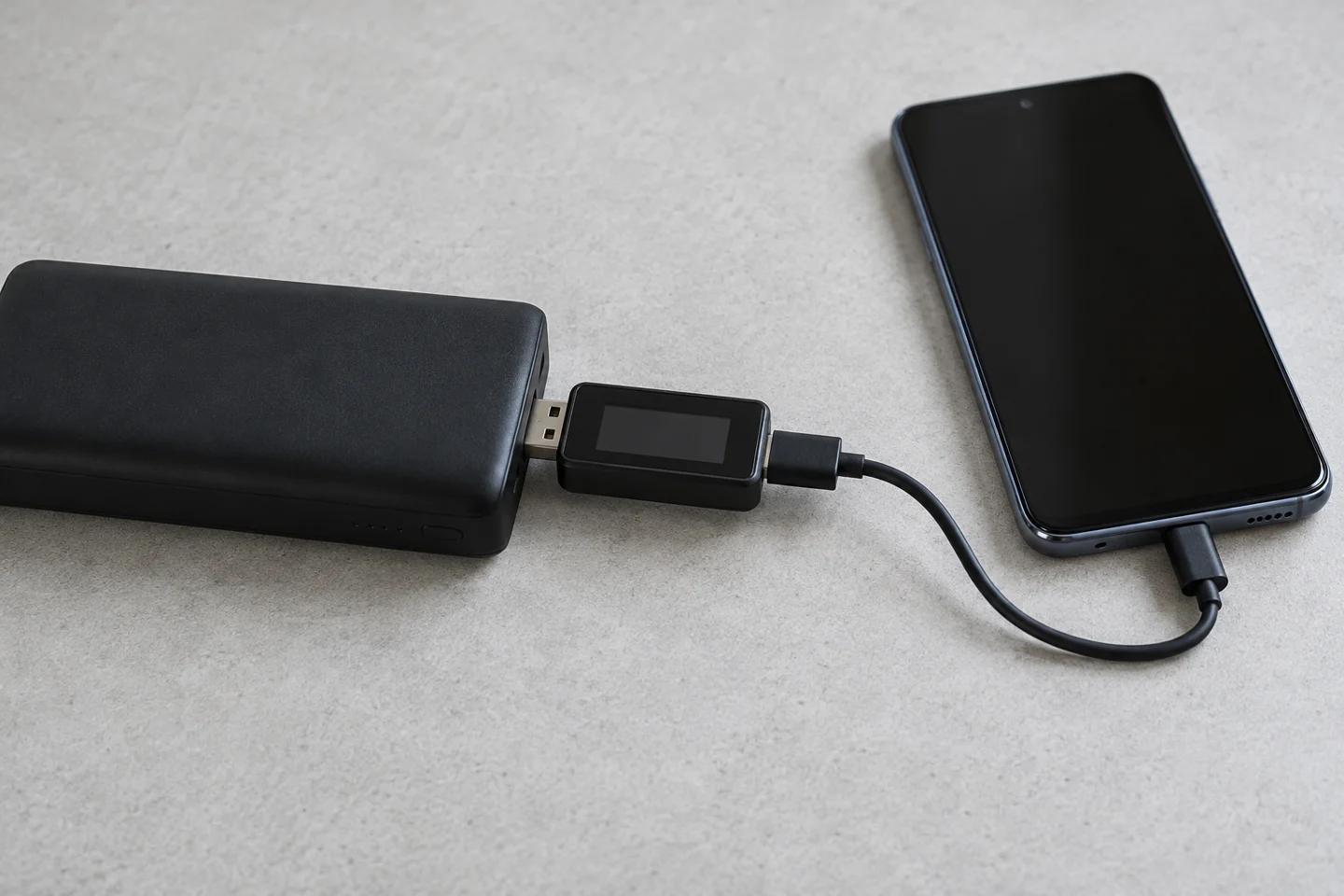
Alongside the result, record the meter identity, output port, cable, load setting and environment. Attach the manufacturer’s comparison condition and the agreed acceptance criterion.
A thin or long cable adds resistance and loses energy. Very high or very low load changes efficiency. Extreme heat or cold reduces measured output.
Review any discrepancy with the recorded setup and comparison condition in view. Keep a follow-up measurement linked to the original record and document the reason for repeating it.
Verify a claimed safety certification by its scope
UL 2056 covers overcharge/discharge protection, short-circuit and overload testing, drop and impact resistance, and thermal safety.
IEC 62133-2:2017 specifies requirements and tests for the safe operation of portable sealed secondary lithium cells and batteries containing non-acid electrolyte, under intended use and reasonably foreseeable misuse.
Product iQ can be used to verify UL certification of a product or component.
For each claimed certification, record the covered object, exact model, document reference and verification outcome. Keep this check alongside the receiving measurements in the order file.
Copy this order-inspection checklist
Use these prompts as the order’s working record. Fill in the actual findings and agree the disposition with the named order reviewer.
Scroll horizontally to see all columns.
| Record | Details to capture |
|---|---|
| Lot identity | Order, supplier, carton references, delivered quantity, model and label photos |
| Document match | Applicable summary, listed model, report identifier, report date and unresolved questions |
| Capacity comparison | Cell rating and voltage; output rating and condition; manufacturer comparison reference |
| Sampling plan | Lot definition, sample selection, defect categories and agreed acceptance rule |
| Sample observations | Unit reference, exterior condition and action taken |
| Output check | Meter, port, cable, load, environment, measured output and acceptance criterion |
| Certification check | Claimed certification, covered object, model and verification outcome |
| Disposition | Release, hold or reject; reason, supporting records, reviewer and date |
For acceptance terms and order follow-through, continue with the first-order risk checklist.
Frequently asked questions
Must the test summary be packed with the shipment?
The test summary need not accompany shipments; the manufacturer or distributor has to make the information available.
When is revised test-summary information required?
New or revised test-summary information is required only if a different design necessitated re-testing.
Sources
- PHMSA — Lithium Battery Test Summaries
- Civil Aviation Authority of Macao SAR — Lithium battery watt-hour calculation
- Xiaomi — Mi Fast Charge Power Bank User Manual
- Energizer Power Packs — Frequently Asked Questions
- NIST/SEMATECH — What Is Acceptance Sampling?
- NIST/SEMATECH — What Kinds of Lot Acceptance Sampling Plans Are There?
- NIST/SEMATECH — How Do You Choose a Single Sampling Plan?
- Anker UK — How to Check Capacity of Power Bank: Rated vs Real Output
- UL Solutions — Power-bank safety testing overview
- IEC — Portable sealed secondary lithium cell and battery safety abstract
- UL Solutions — Product Sourcing and Certifications Database
Related articles
What Power Bank Is Recalled? Check Exact Model and Serial Number
Verify whether a portable charger is under an active CPSC or manufacturer recall by checking exact model codes (Anker A1263, A1257, A1642, A1647, A1652, A1681, A1689, INIU BI-B41), serial strings, and claim rules before disposal.
Read article