
USB-C charging block wattage and PPS
A USB-C charging block wattage is a PDP rating. Separate it from fixed PD voltages, PPS 20 mV steps, shared ports, cable current, and the Level VI mark.
AI-assisted source check; independent human review not recorded. How this guide was prepared
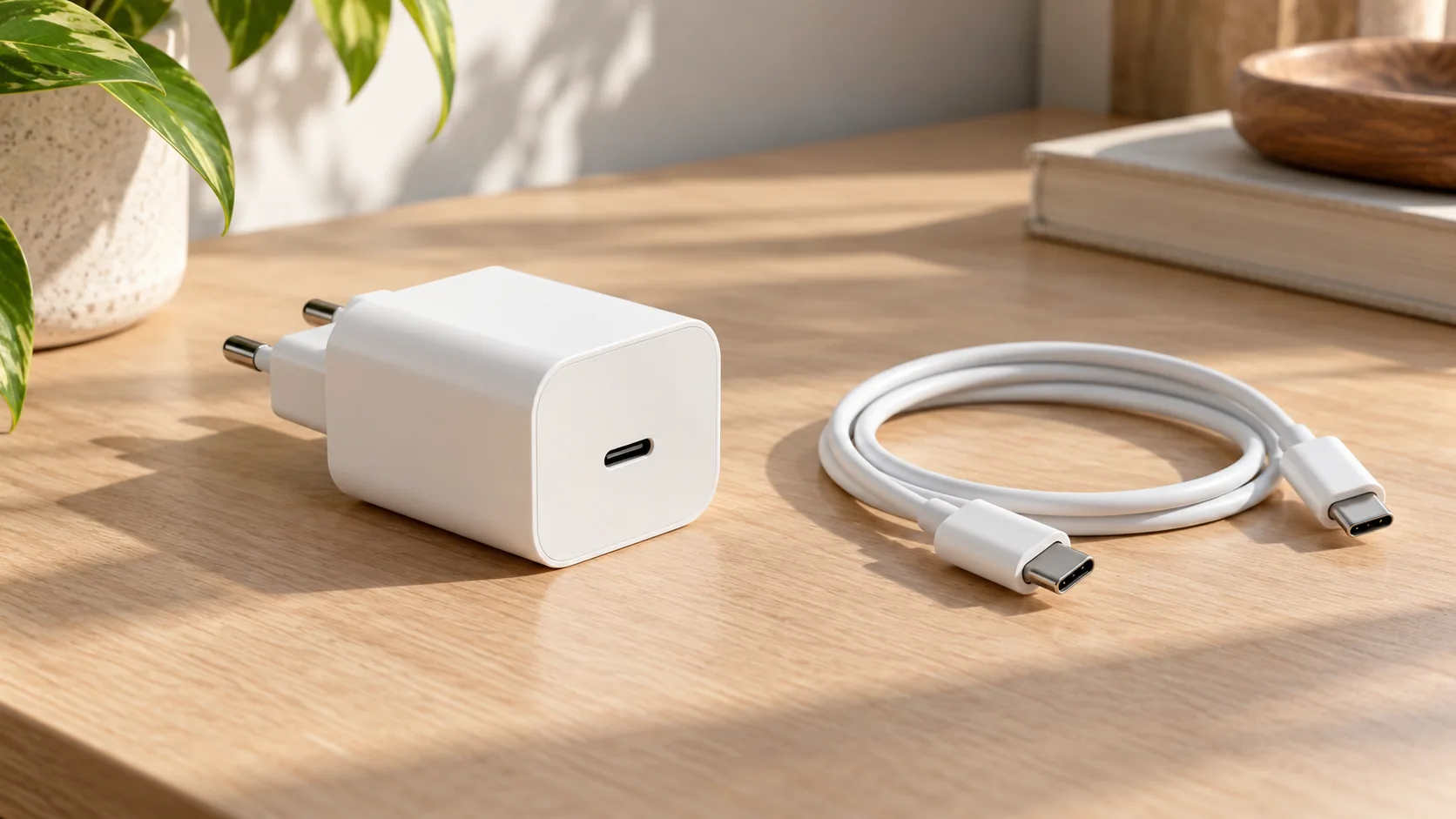
A USB-C charging block’s headline wattage fails as a buying spec when the port split, the cable current, and the PPS request are still unread. The wattage is one power rating. The contract is the voltage and current the source and the sink agree.
Use the charging and power guide to keep the model, the ports, and the cable as separate records. Use the USB-C cable checks for the 60 W and 240 W cable labels, and the Samsung charger checklist when the phone’s listed mode names a PPS range.
Read the wattage as a PDP
USB-IF’s charger documentation states that USB Power Delivery before the 2021 update was limited to 100 W, using 20 V and USB Type-C cables rated at 5 A. The USB Promoter Group’s 2021-05-26 announcement of PD Revision 3.1 sets the new ceiling at 240 W and adds three fixed voltages: 28 V above 100 W, 36 V above 140 W, and 48 V above 180 W. Those sit beside the earlier fixed voltages, 5 V, 9 V, 15 V, and 20 V. The same USB-IF documentation states that the new fixed voltages enable up to 140 W, 180 W, and 240 W.
The 2019 USB-IF developer deck names that packaging wattage the PDP, the Power Delivery Power rating. The source advertises voltages from that PDP. The sink requests one. Power is the product of the agreed voltage and current:
P = V × I
The published pairs divide to 5 A:
100 / 20 = 5
140 / 28 = 5
180 / 36 = 5
240 / 48 = 5
A 100 W PDP at 20 V is therefore a 5.00 A fixed contract when the rounding leaves an exact quotient. It is not a promise that every port on the brick, or a 60 W cable, carries 100 W.
Separate a fixed PDO from PPS
The 2019 deck’s comparison of fixed supplies and programmable supplies, and the USB-IF Power Delivery 3.0 compliance tests version 1.13, give the step sizes. A fixed PDO is one of 5 V, 9 V, 15 V, or 20 V, as far as the PDP reaches. Optional voltages can be added. PPS is a different object. The deck’s 9 V programmable range runs from 3.3 V to 11.0 V. The 5 V range runs from 3.3 V to 5.9 V, the 15 V range from 3.3 V to 16.0 V, and the 20 V range from 3.3 V to 21.0 V. The compliance test says the voltage fields are adjustable in 20 mV steps. The deck sets the current-limit step at a nominal 50 mA and says the sink requests voltage and current at least every 10 seconds. If those requests stop, the source returns to its safe state.
The deck’s own 27 W programmable example is the worked line. At the top of the 9 V range:
I = 27 / 11.0 = 2.4545 A
Round that current down to the nearest 50 mA:
I = 2.45 A
The same 27 W as a fixed 9 V PDO is an exact quotient:
27 / 9 = 3.00 A
Nearest 10 mA and nearest 20 mA both leave 3.00 A. The deck is not silent on the conflict: its PDP overview says fixed current is rounded to the nearest 20 mA, and its fixed-supply slide and comparison table say the nearest 10 mA. These two examples are exact, so the conflict does not move them. For any other PDP, use the rounding on the compliance report for the PD revision you are buying.
The 2021 announcement adds a third mode for the higher voltages. Adjustable voltage supply lets the sink request intermediate voltages from 15 V up to the charger’s maximum fixed voltage, in 100 mV steps, with the maximum at 28 V, 36 V, or 48 V. That 100 mV step is not the PPS 20 mV step.

A printed phone example shows why the range matters. The Samsung checklist summarizes Samsung Singapore’s published specification: EP-T2510 is listed as PDO 9 V / 2.77 A, and as PPS 3.3–5.9 V / 3 A and 3.3–11.0 V / 2.25 A. Those two PPS windows match the deck’s 5 V and 9 V programmable spans. The PPS current at 11.0 V, 2.25 A, is not the PDO current, 2.77 A. Samsung says those charger types and model names vary by country, so a different code stays off this row.
Takeaway: copy the fixed voltages and the PPS windows. A single watt number fills neither column.
Shared ports and the cable current
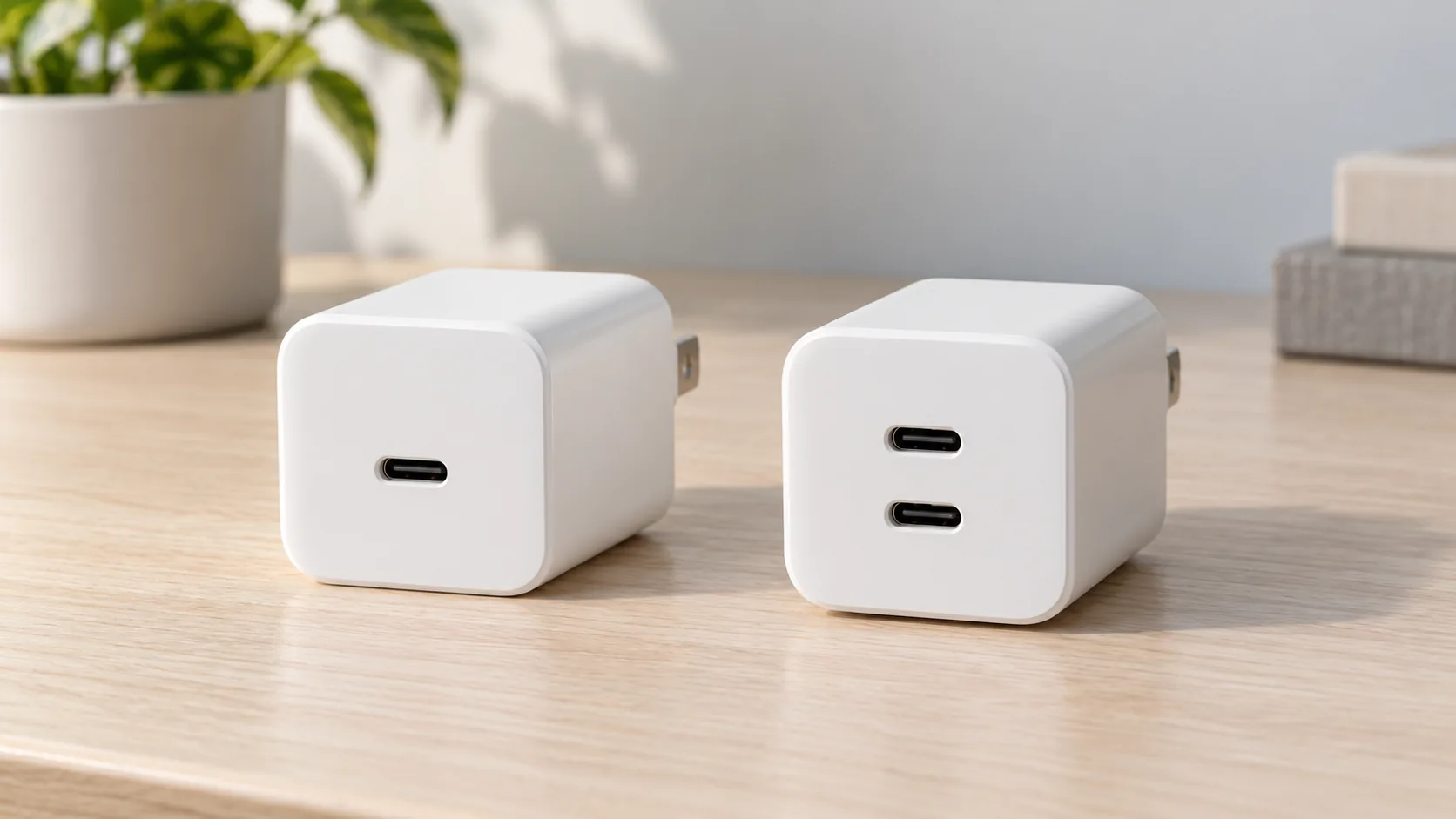
The 2019 deck describes multi-port chargers with shared capacity. Its test mode forces shared-capacity ports to offer their full capabilities, which is the tell: in ordinary use those ports do not each hold the packaging PDP. The Samsung checklist’s EP-T5020 row is one published case. Super Fast charging on that 50 W dual-port charger is listed only on port 1, and it is not supported when two or more ports are connected.
Scroll horizontally to see all columns.
| Offer line | Dominant failure mode | Prevention |
|---|---|---|
| One wattage, more than one port | The second port loses its contract while the first holds a PDO | Record each port with the others connected |
| USB-C shape only | The plug fits, and the source has no PD or no PPS window | Record the fixed voltages and any PPS APDO |
| 100 W PDP with a 60 W cable | 20 V × 3 A is 60 W, so the 5.00 A contract does not fit | Read the cable’s 60 W or 240 W label |
| Roman numeral VI | The mark is an efficiency mark, not a USB-IF PD logo | Check the file number and the PD rows separately |
| A family name such as Anker Nano | The name covers more than one port map | Match the printed model code on the support sheet |
The cable checks record the USB-IF compliance rule: on the USB-C to USB-C compliance path, the power labels required to pass are 60 W or 240 W. That page also records a USB-IF example of 20 V at 3 A marked 60 W. The arithmetic on this page is that pair:
P = 20 × 3 = 60 W
The 2019 deck’s Enter USB cable-current field encodes the same two currents, 3 A or 5 A. A 100 W PDP at 20 V asks for 5.00 A. A cable in the 3 A / 60 W case does not carry that contract. The 2021 announcement is the other label: power above the old 100 W ceiling uses the 240 W cable requirements.
The Anker product-code guide keeps a retail family separate from the printed model. Anker Nano is a family name on retail offers. It does not state a PDP, a PPS window, or a port split. The support page for the printed code does.
Rules of thumb
- If the cable label is 60 W, a 20 V contract stays at 3 A, which is 60 W, even when the brick’s PDP is above 60 W.
- If the printed PDP is above 100 W, record a 240 W cable. The pre-2021 ceiling is 100 W on a 5 A cable.
- If the phone’s listed mode needs a PPS window, a fixed list of 5 V, 9 V, 15 V, and 20 V does not fill a 20 mV request inside that window.
- If two ports can be used together, the packaging PDP is not each port’s simultaneous wattage. The EP-T5020 row drops its fast-charge support when a second port is connected.
Level VI is an efficiency mark
In the 2024 Code of Federal Regulations, 10 CFR 430.32(w)(1)(ii) requires direct-operation external power supplies manufactured on or after 10 February 2016 to meet the standards in that paragraph. Paragraph (w)(1)(iii) assigns Level VI to direct-operation supplies and Level IV to class A indirect-operation supplies. The numeric Level VI table in that CFR edition is a graphic, not text. The same rows are printed as text by Natural Resources Canada, which also names Appendix Z of 10 CFR 430 as a test method. Canada’s dates differ; the formulas below are the shared rows, and the US obligation date is the CFR date.
For a nameplate output P in watts, with 1 < P ≤ 49:
Single-voltage AC-DC, basic-voltage:
η ≥ 0.071 × ln(P) − 0.0014 × P + 0.67
no-load ≤ 0.100 W
Multiple-voltage:
η ≥ 0.075 × ln(P) + 0.561
no-load ≤ 0.300 W
ln is the natural logarithm. A worked nameplate of 20 W, which is an example and not a measured brick:
ln(20) = 2.995732
0.071 × 2.995732 − 0.028 + 0.67 = 0.855
0.075 × 2.995732 + 0.561 = 0.786
The no-load ceilings, held for a year, are:
E = P_nl × 24 × 365 / 1000
0.100 W → 0.876 kWh
0.300 W → 2.628 kWh
The gap between those ceilings is 1.752 kWh a year. That is the difference between two legal caps, not the energy a particular charger draws. The dollar cost is that kilowatt-hour result times the local rate. The unit-price guide is where a landed price and this idle energy sit on the same sheet.
Paragraph (w)(4) requires the supply to be marked under the International Efficiency Marking Protocol. A roman numeral VI is that mark. It does not certify USB PD, PPS, or a port split. An indirect-operation class A supply follows the Level IV rows in the same section: for 1 W to 51 W, 0.09 × ln(P) + 0.5, and a no-load cap of 0.5 W. A medical-device exclusion and a narrow motor-operated battery-charger exclusion are written in paragraphs (w)(6) and (w)(7).
A listing is not a surface-temperature number
UL 62368-1, according to the UL Standards scope definition, applies to external power supplies that primarily supply audio, video, and information-technology equipment, and it does not include requirements for performance. TÜV Rheinland’s FAQ on the same standard says the touch-temperature limit changes with accessibility and expected contact time, and that the limits are based on a standardized 25 °C ambient. There is no single full-load surface-rise number to copy onto every charging block. A foldable prong’s cycle life is not a field in the PD contract or in the DOE wattage rows.
The mark on the plastic is checked in UL Product iQ. The search keyword can be the company name, the model, a category code, or the file number printed with the mark. A free account opens the certification record. When the printed identifier does not open that model, the photograph of the mark is unfinished. UL’s customer-experience address for a record you cannot find is CEC@ul.com, and the published phone number is 877-854-3577.
Takeaway: keep three records apart. The PDP and the PD voltages come from the USB-IF contract and the model’s sheet. The VI mark comes from 10 CFR 430.32(w). The file number comes from Product iQ. None of the three fills the other two.
The surrounding buying guides are on the articles index. Copy one offer per row into the blank charging-block record. The file has headers only.
Sources
- USB-IF, USB Charger (USB Power Delivery). 100 W at 20 V on 5 A cables; 28 V, 36 V, and 48 V up to 140 W, 180 W, and 240 W; adjustable voltage from 15 V.
- USB Promoter Group, USB Power Delivery Revision 3.1 announcement, 2021-05-26. Fixed voltages 28 V, 36 V, and 48 V; adjustable voltage in 100 mV steps.
- USB-IF developer deck, USB Developer Days 2019. PDP, fixed and PPS ranges, 20 mV and 50 mA steps, 10-second PPS requests, shared-capacity ports, and the 3 A / 5 A cable-current field.
- USB-IF, Power Delivery 3.0 Tests, version 1.13, 26 September 2018, section 6.4.1.2.5. PPS voltage adjustable in 20 mV steps.
- 10 CFR 430.32(w), 2024 CFR XML. Direct-operation supplies from 10 February 2016; Level VI versus Level IV; marking rule.
- Natural Resources Canada, External power supplies. Text of the Level VI rows and the indirect-operation rows.
- UL Standards, UL 62368-1 scope. External power supplies are in scope; performance requirements are not.
- TÜV Rheinland, IEC 62368-1 FAQ, item 9. Touch temperature follows contact duration and a 25 °C ambient.
- UL Product iQ search instructions. File number, model, or company name.
Sources checked
Related articles
Open-Box vs Refurbished Electronics: Grading and Returns
Compare open-box and refurbished electronics by published grades, battery evidence, remaining warranty and return terms, then account for a lot's return loss.
Read article
Which Samsung Charger Do You Need?
Match a Galaxy phone or tablet to Samsung's listed charging modes, then check adapter output, PPS, the cable, and ports in use.
Read article
USB-C Charging vs Data Cables: Check Power and Data Separately
Confirm USB-C power, data, and display separately. A cable that charges is not proof it transfers files. Keep the blank capability record.
Read article