
Open-Box vs Refurbished Electronics: Grading and Returns
Compare open-box and refurbished electronics by published grades, battery evidence, remaining warranty and return terms, then account for a lot's return loss.
AI-assisted source check; independent human review not recorded. How this guide was prepared
Confusing open-box and refurbished electronics grading and returns can leave you paying for missing accessories, failed activation or a remedy that has already expired. Open-box describes opened or returned stock, while refurbished describes a stated inspection and restoration process; compare the named program, condition evidence and written remedy before choosing either.
For open-box vs refurbished electronics, grading and returns must be checked separately: an appearance grade cannot establish the refurbishment work, battery condition or return entitlement. Manufacturer-refurbished means the maker’s named program; third-party refurbished means another business performs the work, even when a familiar marketplace hosts the listing. Use the published definitions for that offer, check any remaining original warranty against the actual unit and purchase record, and calculate a lot’s return loss from documented costs or clearly labeled scenario assumptions.
Quick Specs
Scroll horizontally to see all columns.
| Input or item | Typical value or source | Why it matters |
|---|---|---|
| Exact product | Complete model, region and configuration from the unit and listing | Makes offers comparable |
| Refurbishment responsibility | Named manufacturer program or third-party business | Identifies whose process applies |
| Condition grade | That seller’s published definition and actual-item evidence | Prevents an unsupported A/B/C crosswalk |
| Battery and accessories | Applicable program terms plus unit record | Separates appearance from usable equipment |
| Warranty | Provider, coverage dates, territory and purchase evidence | Establishes the service route to verify |
| Returns | Deadline, trigger, remedy, fees and freight responsibility | Defines the remedy’s practical value |
What changes between open-box and refurbished?
The main difference is the offer’s history and stated preparation process, rather than a guaranteed order of quality. An open-box item may be a return or display unit; a refurbished item needs an identifiable refurbisher and a defined work scope. A clean exterior alone answers neither question.
For a concrete open-box example, Best Buy’s Outlet buying guide, read October 19, 2026, describes returned items and some display stock, tested or inspected before condition assignment. Its open-box label therefore does not mean unused. The manufacturer programs discussed below describe their own refurbishment commitments.
The prevention actions in this comparison are purchasing recommendations, not measured failure-frequency rankings.
Scroll horizontally to see all columns.
| Offer route | Process evidence to obtain | Grade and remedy evidence | Dominant Failure Mode & Prevention |
|---|---|---|---|
| Open-box return or display stock | Inspection scope, use history where available, actual contents | Item-specific condition notes and applicable warranty/return terms | Missing accessory or undisclosed wear → inspect the offered unit and itemize contents |
| Manufacturer-refurbished program | Record connecting the unit to the maker’s named program | That program’s condition commitments, warranty and purchase terms | Assuming the brand on the case proves program membership → match invoice and unit to the program |
| Third-party refurbished | Named refurbisher, disclosed replacements and functional-check record | Seller’s grade sheet, battery criteria and identified claim provider | Cosmetic grade masks unresolved battery or activation condition → require those checks separately |
Establish the full model and regional version with the specification comparison guide before comparing condition. A differently configured device does not become equivalent because both listings say Excellent.
How do published grades differ?
Use each program’s definitions without translating its labels into another seller’s A/B/C scale. The following are published program conditions read October 19, 2026, rather than findings about any particular device or lot.
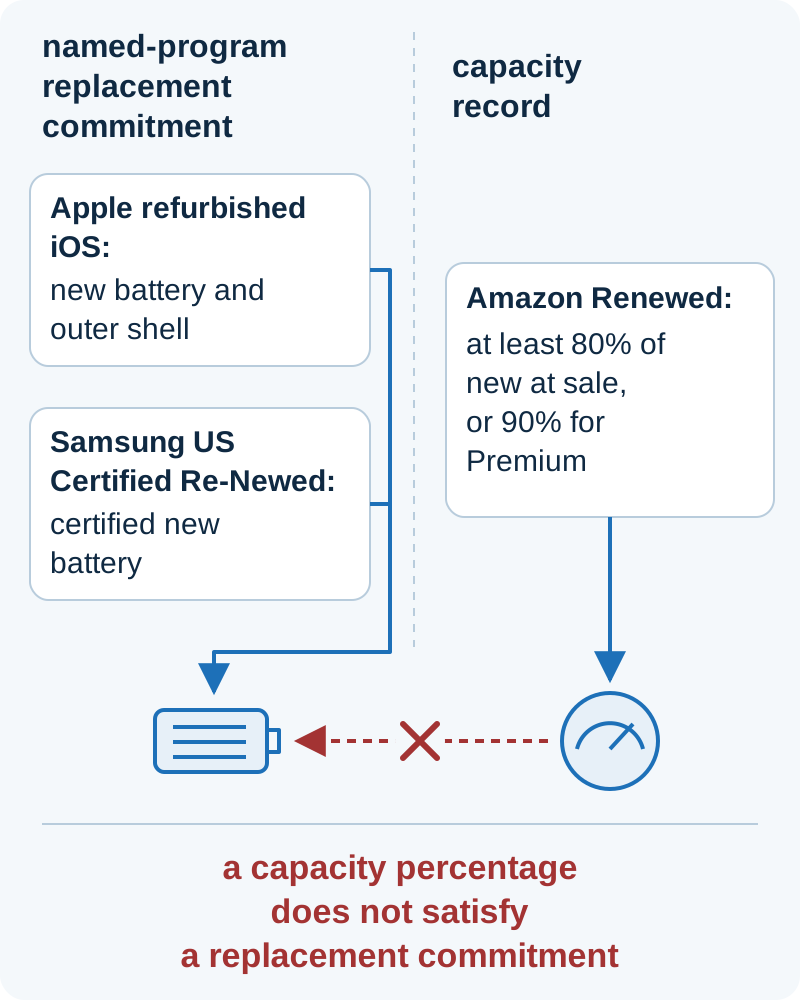
- Apple Certified Refurbished: Apple’s Why Refurbished page specifies functional testing, cleaning and inspection, genuine replacement parts as needed, and a one-year limited warranty. It specifies a new battery and outer shell for refurbished iOS devices; that wording does not extend the same replacement promise to every Mac. The retrieved description publishes no A/B/C scale.
- Samsung Certified Re-Newed, US: Samsung’s program page describes Samsung refurbishment, genuine replacement parts, a certified new battery, a 147-point inspection and a one-year limited warranty for its Certified Re-Newed smartphones. Its retrieved description publishes no A/B/C scale. A third-party listing of a Samsung phone does not establish membership in this program.
- Amazon Renewed: Amazon’s Renewed help page names Premium, Excellent, Good and Acceptable. Excellent and Good have different body-mark criteria at a 12-inch viewing distance; Acceptable allows specified screen and body blemishes. Its battery note specifies at least 80% capacity relative to new at sale, or 90% for Premium. Those thresholds do not promise a new battery. Generic accessories or packaging are possible, and refurbished phones have no guaranteed waterproof seal. Qualified suppliers can be manufacturers or third parties; identify the actual supplier.
- Best Buy open-box: The Outlet guide names Excellent, Good and Fair. Excellent describes no physical flaws; Good allows minor to moderate cosmetic use; Fair allows more significant wear and commonly missing accessories. Read the packaging exception: even Excellent can lack packaging. Record the contents of the actual offer.
For a wholesaler using Grade A, B or C, obtain its published grade sheet before accepting the letter. Record permitted screen marks, case damage, functional exclusions, battery requirement, included accessories and how mixed-grade exceptions are disclosed. If its definition omits battery condition, leave that field unknown. A seller’s Grade A is not automatically Amazon Excellent, Best Buy Excellent or an OEM refurbishment commitment.
How can you check remaining original warranty?
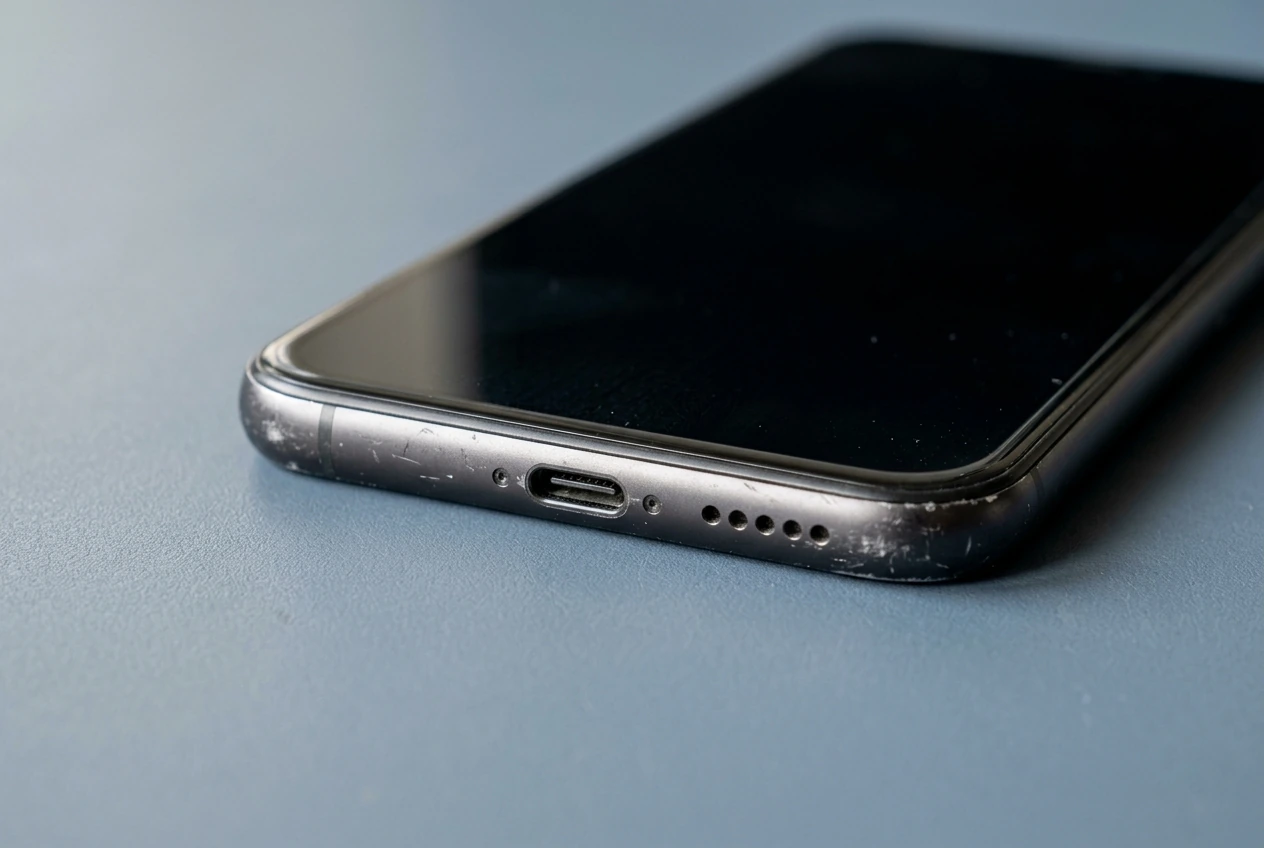
Check coverage for the actual unit and establish whether the intended buyer can use it. Keep remaining original manufacturer coverage, a warranty supplied with a refurbishment program, and a seller’s return remedy as separate records. The one-year OEM program commitments above are not evidence that every resale restarts an original warranty.
Save these fields together:
- Full model and serial number or IMEI, matched to the device rather than only the carton.
- Original purchase evidence where required, plus the invoice for the offered unit.
- Coverage result, date checked, expiry shown and the named warranty provider.
- Intended service country, ownership or transfer conditions, and relevant exclusions from the applicable warranty.
- The provider’s written resolution if the dates or the buyer’s eligibility remain unclear.
Apple documents coverage information and expiry checks, and says an incorrect estimated Limited Warranty or AppleCare expiry may require purchase-date correction with original proof of purchase. Samsung’s US registration guidance explains purchase-evidence validation; its listed rules exclude private used purchases, as-is units and outside-Samsung refurbishment as evidence for updating the purchase date. That is a purchase-date validation limit, not a blanket ruling on every secondhand warranty claim. These instructions were read October 19, 2026.
A lookup is a coverage record to investigate, not a substitute for checking entitlement. For a lot, one unit’s result does not establish coverage for the others. If remaining original coverage cannot be confirmed, keep it out of the claimed benefit and evaluate the documented seller remedy on its own terms.
The FTC’s Businessperson’s Guide to Federal Warranty Law, read October 19, 2026, explains that Magnuson-Moss does not require a written warranty. Used-goods merchantability concerns expected use given the product’s type and price, with merchant-sale and state-law conditions. A business providing its own written consumer-product warranty cannot simply disclaim implied warranties. The guide excludes products sold for resale from the Act’s scope; do not import retail consumer-warranty assumptions into a wholesale resale contract.
Which return terms must be fixed before buying?
Fix the deadline, qualifying condition and cost allocation in writing before relying on a return promise. A long warranty does not itself establish a change-of-mind refund, and a return policy does not resolve every later repair claim.
Best Buy’s Return & Exchange Policy, read October 19, 2026, starts the period on receipt and includes open-box and refurbished purchases. Most products have 15 days under Standard terms, or 60 days for eligible Plus/Total members; activatable devices generally have 14 days, with a 30-day Verizon exception. Marketplace purchases do not receive the membership extension. Restocking fees, exclusions and shipping restrictions require a category-specific check.
Amazon’s retrieved help page confirms the Renewed Guarantee, while its supplier program page says suppliers back it and are responsible for claims. Save the guarantee wording and duration attached to the exact offer; the program name alone does not supply the deadline in your purchase record.
For any offer, record when the clock starts, the final date and timezone, whether authorization, dispatch or arrival must occur by then, and whether the remedy is repair, replacement, refund or credit. Identify who pays freight and packing costs, any fees, and how missing contents or failed activation are handled. For a lot, agree whether a claim can concern individual units or requires returning the whole lot; retain the serial list and arrival evidence.
Rules-of-Thumb: If remaining return time is less than the time needed to finish checks and satisfy the seller’s claim deadline → choose a longer written window or finish verification before committing, because a defect discovered after the deadline may lose the return route. For example, 2 calendar days remaining is less than a 3-calendar-day check-and-claim plan; these are buyer planning assumptions, not program policy periods. Include transit time when the deadline requires receipt.
How do you account for a lot’s return loss?
Calculate the net cost of documented incidents, or show explicitly assumed incident counts before purchase. Do not turn a grade, a sample check or a return policy into a forecast return rate.
For incidents with the same assumed costs:
Lot return loss L = n × (U + F + P + t × w)
Here, n is the affected-unit count, U is unrecovered device-value loss per incident after credits and resale or salvage recovery, F is unreimbursed freight per incident, P is packing material per incident, t is handling/repacking hours per incident, and w is labor cost per hour. All monetary inputs use one currency. If incidents have different costs, calculate each separately and add them.
Worked example — assumed costs, not a return forecast
Every input below is a scenario assumption. CU means currency units; these are handling and net-loss inputs, not quoted device prices.
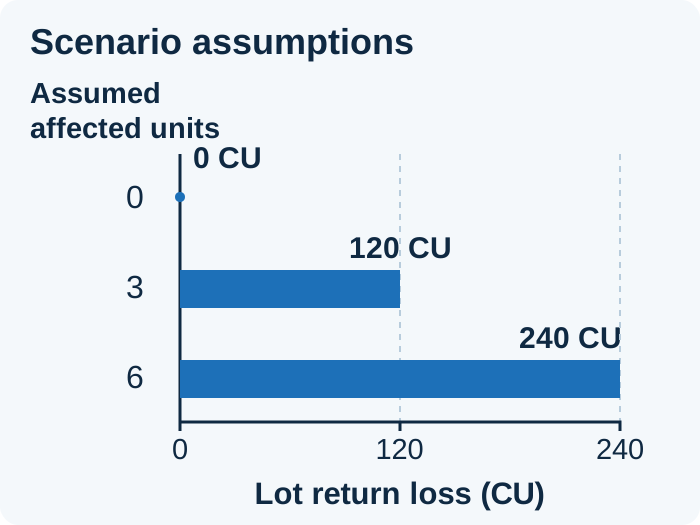
- Assume a lot contains 50 received units and a scenario has 3 affected units. For each affected unit, assume U = 20 CU, F = 12 CU, P = 3 CU, t = 0.25 hour and w = 20 CU/hour.
- Calculate L = 3 × (20 + 12 + 3 + 0.25 × 20) = 120 CU. Allocated across the received lot, 120 CU / 50 units = 2.40 CU per received unit.
- Change only the assumed count: 0 affected units → 0 CU, while 6 affected units → 240 CU. This sensitivity check shows the consequence of different counts; it establishes no expected return rate.
Count each recovery once. If a supplier credit has already reduced U, do not subtract it again from L. A returned device that can be resold is not automatically a total device-value loss. When using purchase cost minus recovery to calculate U, do not add that purchase cost a second time to total ownership cost. Keep open claims separate from credits actually received.
TCO note: returns can add freight, packing materials, repacking time and unavailable-device time. Failed activation needs its own recorded cause and remedy; lost or unconfirmed warranty coverage leaves a potential future repair exposure. Quantify these only from records or labeled assumptions, keep future exposure separate from realized return loss, and use the total-order-cost guide to combine costs without counting the same loss twice.
What should you keep before accepting the offer?
Keep a dated verification record connecting the offered unit or lot to its grade, battery evidence, accessories, warranty route and return deadline. Save the listing and terms as they stood when you agreed to buy, with unresolved items assigned to a named person.
Download the blank open-box and refurbished grade record to capture these fields for each unit or lot. It contains column headers only; fill it from the offer and your verification records.
Use the supplier verification guide to check the business responsible for refurbishment and claims. Carry the agreed serial list, acceptance conditions and deadlines into the first-order risk checklist. For the broader assessment of refurbishment records and receipt evidence, continue with the refurbished electronics buying guide.
Return to Buying Guides for the product-definition stage, or the articles directory for the next purchasing question.
Method and sources
This comparison uses the public US Apple Certified Refurbished and Samsung Certified Re-Newed program descriptions, Amazon Renewed condition help and supplier requirements, Best Buy Outlet and Return & Exchange Policy, the linked OEM coverage instructions, and the FTC warranty guide. Sources were read October 19, 2026. Their titles and links appear beside the claims they support; their conditions apply to the named programs, not to every offer carrying the brand.
The purchase checks and failure-prevention actions are editorial recommendations. The loss formula is an accounting model, and every numerical input in its worked example is an explicit scenario assumption. No lot return-rate estimate or universal A/B/C mapping follows from these sources. The dedicated Amazon guarantee detail could not be retrieved as substantive text, so no guarantee duration is asserted here; confirm the exact offer’s terms before relying on it.
Updated October 19, 2026.
Sources checked
Related articles
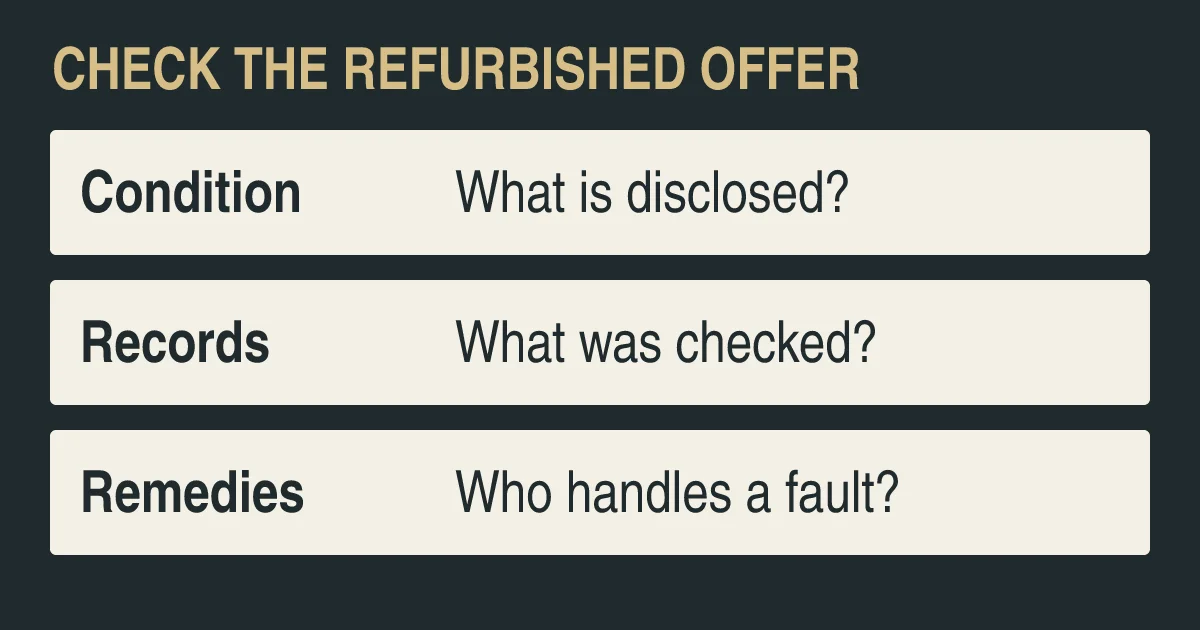
Refurbished Electronics: Check the Offer
Decide whether a refurbished electronics offer is worth considering by checking condition, repair records, warranty terms and receipt evidence.
Read article
USB-C charging block wattage and PPS
A USB-C charging block wattage is a PDP rating. Separate it from fixed PD voltages, PPS 20 mV steps, shared ports, cable current, and the Level VI mark.
Read article
Which Samsung Charger Do You Need?
Match a Galaxy phone or tablet to Samsung's listed charging modes, then check adapter output, PPS, the cable, and ports in use.
Read article