
Refurbished Electronics: Check the Offer
Decide whether a refurbished electronics offer is worth considering by checking condition, repair records, warranty terms and receipt evidence.
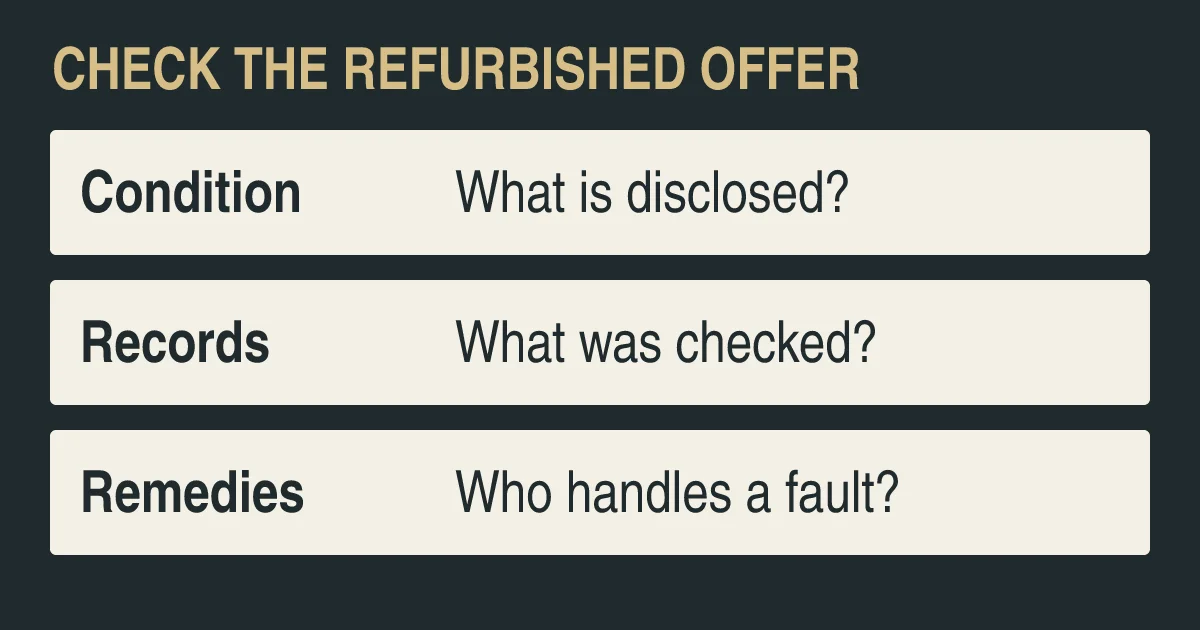
Illustration: compare the evidence behind an offer, not only its condition label.
A cheap refurbished device can cost more if it arrives with undocumented repairs or cannot do the job you bought it for. Consider the offer only when its condition, functional evidence and written remedies meet your requirements; the word “refurbished” cannot establish those facts by itself.
This is a document-based buying guide, not our reliability test or a recommendation of stores. It covers individual purchases and the evidence needed to assess a wholesale lot. Apple Certified Refurbished appears as a specific manufacturer program example, not as a benchmark that every seller follows.
Scroll horizontally to see all columns.
| Decision input | What to record | What remains unknown without it |
|---|---|---|
| Exact device | Model, regional variant and configuration | Whether the quoted unit meets your requirement |
| Refurbishment responsibility | Named business and stated process | Who performed the work |
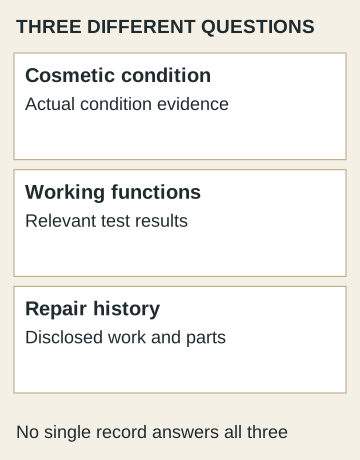
| Functional evidence | Dated results linked to a unit or lot | Which functions were actually checked |
| Replaced parts | Repair record and disclosed replacements | What changed before resale |
| Written remedies | Warranty provider and return conditions | Who deals with a problem, and how |
| Receipt checks | Agreed acceptance steps and reporting route | How a mismatch will be documented |
Read the refurbishment claim before judging the price
Treat “refurbished” as a claim about work performed before resale, then ask what that work included. Do not infer a shared testing standard from a label such as “renewed,” “certified” or a cosmetic grade.
Apple’s US Certified Refurbished description specifies functional testing, cleaning and inspection, genuine replacement parts where needed, and a one-year limited warranty. Those are statements about Apple’s named program. An independent seller offering an Apple device has not thereby shown that the device belongs to that program.
Scroll horizontally to see all columns.
| Listing language | Evidence to request | Conclusion to avoid |
|---|---|---|
| Manufacturer refurbished | Applicable program terms and a record connecting the offer to it | The brand printed on the device proves program membership |
| Seller refurbished | Named refurbisher, work scope and test record | A familiar marketplace performed the refurbishment |
| Used or preowned | Actual condition, disclosed work and any inspection evidence | Previous ownership proves that repairs or tests occurred |
| Open box | Reason for opening, completeness and use history where known | The contents are unused or identical to a sealed new unit |
| Grade A, excellent or similar | That seller’s written grading definition and actual condition evidence | A cosmetic grade establishes battery condition or service life |
These are questions to resolve, not universal legal definitions. The FTC’s marketplace buying guidance advises reading condition descriptions and checking actual-item photographs rather than relying on stock images. For a bulk offer, ask how the pictures relate to the lot and how exceptions are disclosed.
Use the specification comparison guide to establish exact product identity before treating two listings as equivalent.
Takeaway: Convert the label into a written description of the work and condition you are buying.
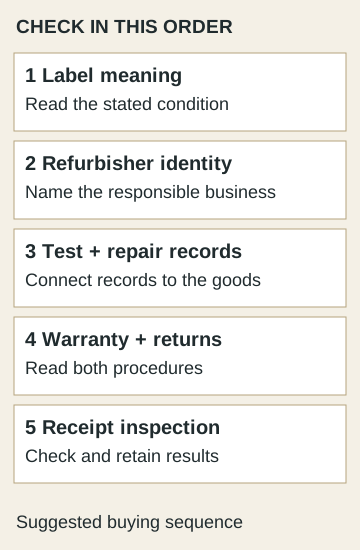
Ask who did the work and which records follow the goods
Request records that can be connected to the offered unit or lot. A sample test report explains a process, but it cannot establish the condition of every item in a later shipment.
Ask for the refurbisher’s identity, the inspection date, the functions tested and the result format. Record disclosed repairs separately from test results. A statement that a device powers on answers a narrower question than a record covering the functions your purchase requires. If the seller cannot share a full internal report, ask for a written summary and identify what remains unverified.
For a mixed lot, request the model and condition breakdown, how unit identifiers will be supplied, and whether results cover every unit or a sample. State how undisclosed substitutions or failed units will be handled before agreeing to the order. These are suggested procurement fields, not a claim that every refurbisher supplies the same documentation.
The supplier evidence checklist covers the separate job of checking the business and its claims. If several parties appear on the paperwork, the distributor, wholesaler and reseller guide helps frame questions about their roles.
Common mistake: Treating a sample certificate as proof that the quoted serial numbers passed the same checks. Record which units the document actually covers.
Takeaway: Keep the business identity, work record and goods identifiers connected in the purchasing file.
Match the inspection to the electronics category
Choose checks from the intended use and exact model, rather than requesting an undefined “fully tested” promise. The following matrix is a suggested starting point; manufacturer procedures and the purchase agreement govern the actual inspection.
Scroll horizontally to see all columns.
| Category | Evidence to request before ordering | Practical receipt check to agree |
|---|---|---|
| Phones and tablets | Exact variant, battery condition evidence, disclosed repairs and setup eligibility | Complete ordinary setup and check the required camera, audio, display and connection functions |
| Computers | Configuration, storage and memory identity, battery information where applicable | Confirm the delivered configuration and required ports and applications |
| Displays and audio equipment | Model, accessories, cosmetic exceptions and functional check scope | Check the intended inputs, controls and output under ordinary use |
| Networking equipment | Hardware revision, firmware information and any account or license dependencies | Confirm access to required configuration functions and the planned network role |
| Chargers and power accessories | Exact model, electrical ratings, connector and included cable identity | Match labels and accessories to the agreed specification; do not improvise electrical safety tests |
Our mobile-phone research, networking and communications research and charging and power research provide category context. None replaces a unit-specific inspection report.
For preowned iPhones, Apple’s inspection guidance covers condition, battery information and functional checks. It also says not to buy an Activation Locked iPhone. Treat inability to complete legitimate setup as an unresolved acceptance issue; do not assume a repair record resolves ownership restrictions.
Takeaway: Define the functions that matter to this purchase and retain the result for each agreed check.
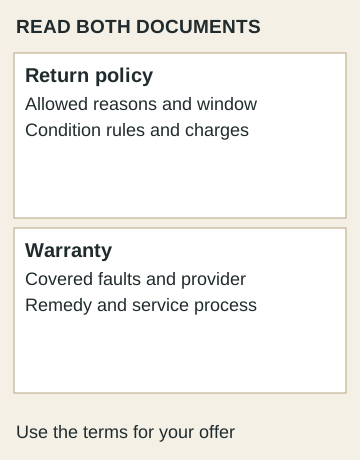
Separate warranty coverage from permission to return
Read the applicable documents before paying. A warranty describes a response to covered problems; a return policy states when and how the seller will accept an item back. Do not assume they cover the same reasons or use the same deadline.
The FTC’s warranty guidance recommends checking the duration, covered parts, available remedies and claims process. Keep the written warranty with the receipt. For your offer, record the provider, coverage start, exclusions, service destination and responsibility for shipping or labor charges.
For returns, save the applicable window, allowed reasons, condition requirements, authorization process and charges. If the seller promises an exception in a message, retain that message with the order. Ask what happens when a unit fails on arrival rather than assuming an ordinary change-of-mind policy answers that question.
Do not copy Apple’s one-year program warranty onto a seller-refurbished offer. Likewise, consumer guidance from the United States does not establish the terms of a cross-border business purchase. Check the documents applicable to your transaction and jurisdiction.
Takeaway: Record two routes: the applicable return procedure and the provider’s warranty procedure.
Compare complete offers after resolving the missing evidence
Compare offers with the same model, configuration, disclosed condition, accessories and service scope. A lower device price may exclude something required for the job. The total-order cost guide explains how to keep those cost assumptions visible without treating uncertain expenses as zero.
Create a short comparison record with columns for the requirement, seller’s answer, supporting document and unresolved action. Put “not provided” where the seller has not answered. Avoid assuming an unverified probability of failure or an expected repair cost to produce a precise-looking savings figure.
For example, two quotes may describe the same capacity while only one identifies the included power adapter and service destination. The immediate conclusion is that the offers need clarification, not that either seller is cheaper or more reliable. This is an illustrative paperwork comparison, not an observed transaction.
Use the downloadable specification worksheet for the shared product fields. Add the refurbishment record and remedies alongside them. Keep technical assumptions separate from commercial terms so another buyer can reproduce the comparison.
Common mistake: Accepting “tested” as a complete answer while negotiating the price in detail. An unresolved required function remains unresolved after a discount.
Takeaway: Judge value after aligning what the offers include and documenting the remaining uncertainty.
Inspect on receipt while the reporting route is still available
Arrange a receipt check before ordering, so the inspection does not start with a search for the seller’s terms. The first-order checklist helps organize responsibilities around payment, shipment and receipt.
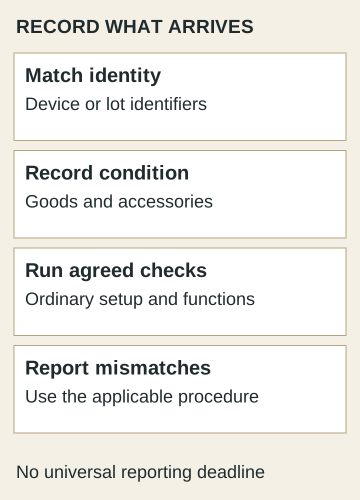
On arrival, record the package and goods identifiers, visible condition and included accessories. Compare them with the agreed list, then perform the ordinary setup and functional checks appropriate to the device. Preserve the original listing, correspondence and dated observations when a mismatch appears. Report through the applicable process within the seller’s stated deadline, as claim periods vary by contract and sales channel.
For a lot, keep the result linked to each checked unit and distinguish uninspected items from passed ones. Do not extrapolate a sample result into a promise that every device will last a particular time. If an item shows damage that makes ordinary use questionable, stop the check and obtain appropriate service advice rather than opening or stress-testing it to create evidence.
Takeaway: Capture the agreed evidence promptly, and distinguish checked, failed and uninspected units.
When this guide is not enough
Pause when an essential requirement remains unsupported, the claimed program cannot be connected to the goods, or the remedies cannot be used in the intended market. A larger discount does not resolve those gaps.
This guide does not establish electrical safety, compliance for a regulated use, software licensing rights or a resale business’s legal obligations. It does not compare refurbished laptops with new models, recommend platforms, or estimate failure rates. Those decisions require their own evidence. Use the articles directory to locate the relevant next guide.
Return to the buying and specification resources with an offer record that another person can inspect. The useful outcome is a documented decision to proceed, request clarification or decline, with reasons tied to the actual offer.
Takeaway: Stop where a required fact is missing; do not turn an attractive price into substitute evidence.
Frequently asked questions
Should I choose a new battery rather than a standard battery?
Ask what each option means and who made the replacement, rather than comparing labels alone. Apple’s US program specifically promises a new battery and outer shell for refurbished iOS devices; do not extend that statement to every product or independent refurbisher. A seller’s “new battery” option needs its own documented terms and condition evidence. See Apple’s program description.
Are refurbished phones still water resistant?
Do not use a model’s original rating as proof of the current unit’s resistance. Apple says splash, water and dust resistance are not permanent and can decrease with normal wear; it advises against disassembly. Ask for any applicable post-repair claims in writing, and do not submerge a purchased phone to test them yourself.
Does an Unknown Part message prove the part is counterfeit?
No. Apple’s Parts and Service History guidance lists several possible reasons, including a nongenuine part, a part not working as expected, or a part not verified and linked after repair. The message needs investigation, not an automatic diagnosis. Ask the seller to explain it against the actual repair record and agreed condition.
Is an extended warranty worth adding to a refurbished device?
Compare the proposed service contract with the coverage already included. The FTC explains that a separately purchased service contract differs from a product warranty and may overlap it. Check the extra coverage, charges and claim procedure; the word “extended” does not establish value. This guide has no failure data from which to calculate a financial return.
Does refurbished mean the phone is carrier unlocked?
No: refurbishment and carrier restrictions answer different questions. For an iPhone, Apple explains how to inspect Carrier Lock under Settings, General, About; “No SIM restrictions” indicates it is unlocked. Follow the relevant manufacturer’s and carrier’s instructions for other devices. That status is separate from Activation Lock and does not itself establish network compatibility.
Can independent repair automatically void a US consumer warranty?
The FTC gives a specific example: an unexpired warranty covers a later repair unrelated to earlier work by an independent shop, so the manufacturer cannot refuse that covered repair merely because of the earlier independent work. This does not make every fault a covered claim. Preserve the stated reason for a denial and consult the relevant consumer-protection office about your circumstances.
Methods and sources
Sources checked: October 7, 2026 (2026-10-07). AI-assisted source review; no independent human review recorded.
ElectronicSeek Editorial Desk prepared this AI-assisted guide from the official sources below, checked October 7, 2026. We did not buy devices, inspect seller stock or measure reliability. The matrices and diagrams are suggested purchasing tools, not certification standards. Brand-specific examples retain their product and market limits; US consumer guidance is not individualized legal advice or a rule for every wholesale transaction.
The six FAQ topics reflect battery-option, water-resistance, parts-warning, extra-coverage and carrier-lock questions posted by buyers, plus the FTC’s published repair question. These establish the questions, not the factual answers; forum replies were not used as policy evidence.
Related articles
Open-Box vs Refurbished Electronics: Grading and Returns
Compare open-box and refurbished electronics by published grades, battery evidence, remaining warranty and return terms, then account for a lot's return loss.
Read article
USB-C charging block wattage and PPS
A USB-C charging block wattage is a PDP rating. Separate it from fixed PD voltages, PPS 20 mV steps, shared ports, cable current, and the Level VI mark.
Read article
Which Samsung Charger Do You Need?
Match a Galaxy phone or tablet to Samsung's listed charging modes, then check adapter output, PPS, the cable, and ports in use.
Read article