
USB-C to Lightning Cable Check: MFi C94 vs. Cloned Chips
Verify a USB-C cable to Lightning before accepting bulk stock: check the MFi database, C94 rhodium-ruthenium pins, PD protocol readouts, 3A IR drop, and SR flex life.
AI-assisted research. Editorial responsibility: ElectronicSeek Editorial Desk; see our editorial methodology. How this guide was prepared
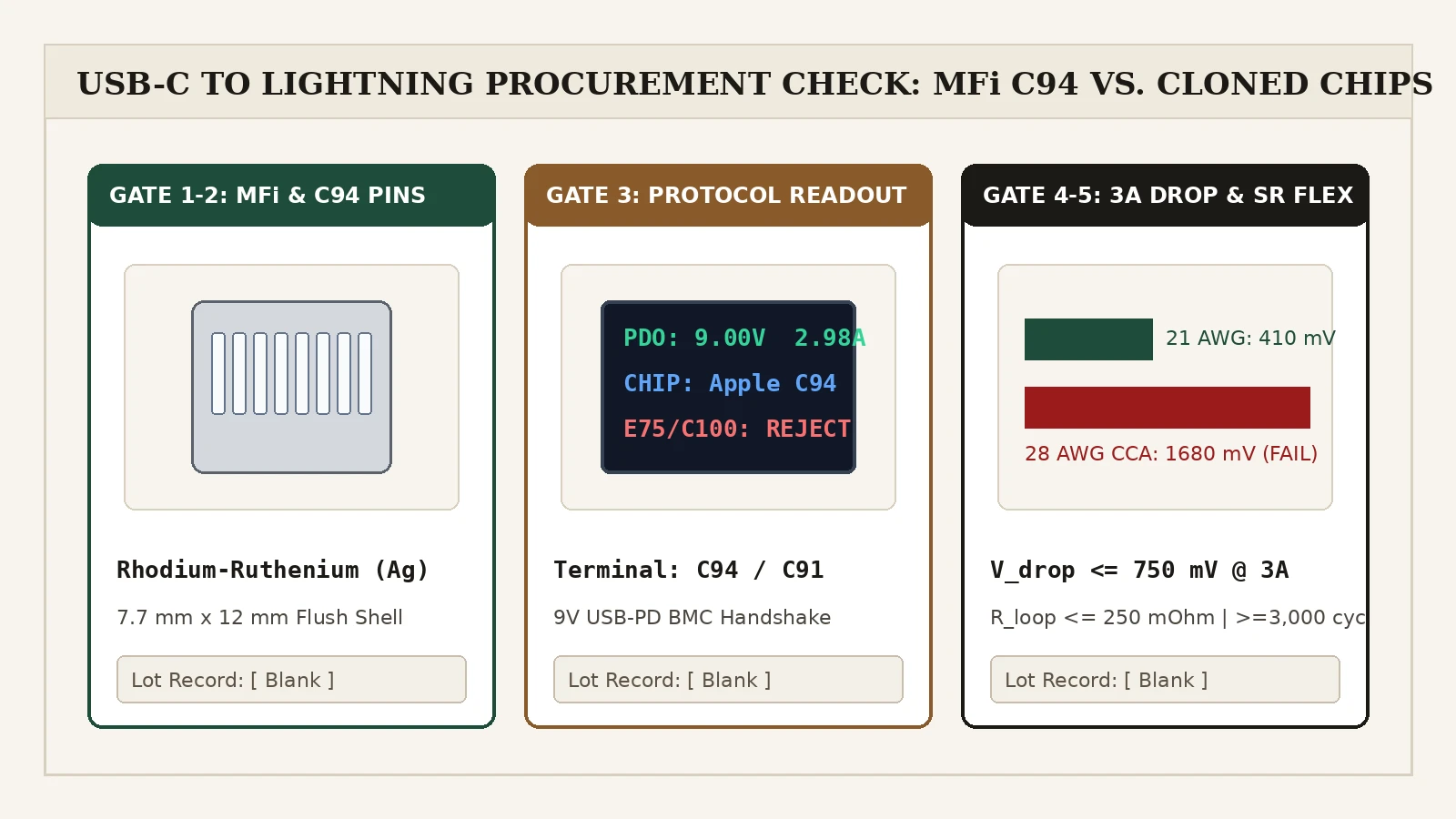
Accepting a bulk usb-c cable to lightning shipment based on a single desk plug-in causes costly field returns, connector overheating, and customs rejections when suppliers substitute cloned ASIC chips or undersized wires. Before releasing supplier payment, verify the exact model in Apple’s public MFi database, inspect the C94 rhodium-ruthenium contact pins, confirm 9V USB-PD protocol readouts, and measure DC voltage drop under a 3A constant-current load.
For wholesale accessory buyers, phone refurbishers bundling cables with iPhone 8 through iPhone 14 stock, and enterprise IT teams evaluating an apple usb-c cable or an iphone charger original accessory offer, a fast-charge chime on one phone does not prove MFi compliance. Apple’s MFi licensing program supplies only the C94 terminal module for third-party USB-C to Lightning fast-charging cables (and uses the C91 module in first-party Apple retail cables). Uncertified assemblies routinely pair cracked E75 or C100 authentication chips with 26–28 AWG copper-clad aluminum (CCA) cores that fail after iOS updates, drop more than 1.2V under a 3A load, or trigger U.S. Customs and Border Protection seizure under 19 CFR Part 133 when stamped with counterfeit Apple markings.
This verification record sits under the charging and power verification guide and the sourcing and verification hub. When your shipment includes USB-C to USB-C cords for iPhone 15 or newer handsets, separate those SKUs and run the USB-C charging and data cable checks. When evaluating the wall adapter paired with the cable, use the USB-C charging block wattage and PPS guide and the Samsung charger authenticity evidence record. Keep supplier entity checks on the supplier evaluation guide and pre-shipment hold rules on the first-order risk checklist.
Scroll horizontally to see all columns.
| Step | Inspection Gate | Method & Tool | Pass Criterion (Genuine C94 / Apple C91) | Reject / Stop Condition (Cloned E75 / Counterfeit) | Your Lot Record |
|---|---|---|---|---|---|
| 1 | MFi Public Registry & IPR Check | Query Apple’s MFi Licensed Accessories database by Brand, Model, and UPC/EAN; verify trademark authorization under 19 CFR Part 133 | Exact Brand, SKU Model Number, and retail UPC/EAN appear active in Apple’s public registry; first-party Apple OEM lots trace to authorized distributor invoices | Brand/Model/UPC absent from registry; seller offers only an unverified PDF certificate from another factory; unauthorized "Designed by Apple in California" jacket text |
|
| 2 | Physical Connector & Shield Anatomy | Digital caliper + 10× loupe check against Apple’s counterfeit Lightning criteria + 2-unit destructive shell decapsulation | Single-piece, smooth, rounded silver-colored rhodium-ruthenium pins; uniform 7.7 mm × 12 mm shell; flush grey/metallic insert; 6-point laser-welded stainless ground shield |
Gold-plated contacts on a USB-C to Lightning SKU (C48/C89 USB-A part); rough squared pins; recessed faceplate gap; crimped or spot-glued tin shield |
|
| 3 | USB-PD Handshake & Terminal ASIC Readout | Inline MFi/PD protocol analyzer (e.g., ChargerLAB POWER-Z KM003C / MF001) + ≥20W USB-PD source per Apple fast-charge specs | Negotiates 9V fixed PDO (9V ⎓ 2.22A or 9V ⎓ 3A) over Type-C CC line; reads C94 (third-party MFi) or C91 (Apple OEM) with unique serials per cable |
Fails 9V PD step-up; protocol tester reads E75, C100, C89, or C48; identical frozen serial string repeated across multiple cables in carton |
|
| 4 | 3A Constant-Current IR Drop & Wire Gauge | Electronic load at 3.00A DC + 4-wire Kelvin milliohmmeter per USB-IF Type-C cable requirements + wire strand micrometer |
VBUS drop ≤ 500 mV and GND drop ≤ 250 mV (≤ 750 mV total loop drop at 3A; R_loop ≤ 250 mΩ); 21–22 AWG (1m) or 20–21 AWG (2m) tinned OFC copper |
Total loop drop > 750 mV at 3A (R_loop > 250 mΩ); sink voltage sags below 8.25V on a 9.0V rail; 26–28 AWG copper-clad aluminum (CCA) strands |
|
| 5 | Strain-Relief (SR) Flex Life & Jacket Build | EIA-364-41 swing flex tester (±60° or ±90°, 30 cycles/min, 300 g–500 g load) + SR overmold cross-section |
Survives ≥ 3,000 cycles (standard TPE SR) or ≥ 10,000 cycles (braided/silicone SR) with ≤ 10% resistance rise; aramid tensile fibers anchored in crimp |
Jacket splits at SR neck or VBUS/CC opens under 1,000 cycles; hard PVC short boot with no internal interlock; missing aramid core yarn |
Download the blank USB-C to Lightning C94 lot inspection checklist and attach it to your purchase order or pre-shipment inspection (PSI) report. Leave the measurement cells blank until your incoming quality control (IQC) team records actual sample values from the shipment.
Step 1: Verify the Exact Brand, Model, and UPC/EAN in Apple’s Public MFi Database
Every B2B verification workflow for a usb-c cable to lightning lot starts with documentary identity before touching a single carton. Through the official Apple MFi licensing program, Apple supplies proprietary authentication chips and Lightning connector modules exclusively to licensed manufacturing partners via authorized MFi component distributors (Avnet and Arrow). Apple splits membership into Developer/Manufacturing Licensees (factories authorized to purchase raw C94 terminals and assemble cables) and Brand Licensees (retail brands authorized to market finished accessories under their own trademark and barcode).
A widespread sourcing failure mode occurs when a trading company sends a PDF screenshot of an MFi factory certificate belonging to an unrelated OEM contract manufacturer while shipping uncertified grey-market stock under your private label or an unlisted box brand. To prevent this gap, open Apple’s MFi Licensed Accessories public search and verify three exact strings against the physical packaging and commercial invoice:
- Brand Name: The exact consumer-facing brand printed on the retail box and invoice.
- Model Number: The exact alphanumeric SKU string printed on the packaging label and cable tag.
- UPC / EAN Barcode: The 12-digit UPC or 13-digit EAN barcode assigned to that specific cable length, color, and packaging configuration.
If a supplier claims a third-party cable is MFi certified but the Brand, Model, and UPC/EAN combination does not appear in the public database, hold the order immediately. An OEM factory’s internal manufacturing license does not authorize selling unbranded or differently branded cables bearing the MFi badge until the brand owner completes an MFi product plan and public listing registration.
Customs Seizure Risk on “Original Apple” Grey-Market Lots (19 CFR Part 133)
Refurbishers and wholesale buyers searching for an apple usb-c cable or an iphone charger original bundle must separate licensed third-party MFi C94 cables from lots marketed as “OEM Original Apple Bulk / Foxconn Factory Overrun.” Under U.S. Customs and Border Protection trademark enforcement rules in 19 CFR Part 133 (Subpart C, §§ 133.21–133.27), importing cables or power adapters bearing counterfeit or unauthorized recorded trademarks—including the Apple logo, "Designed by Apple in California" jacket text, Lightning connector trade dress, or unauthorized MFi certification marks—triggers mandatory detention, seizure, and summary forfeiture.
Furthermore, under 19 U.S.C. 1526(f), CBP assesses civil fines against the importer of record equal to the manufacturer’s suggested retail price (domestic value) of the genuine Apple merchandise for a first offense, and twice the domestic value for subsequent seizures, regardless of whether the overseas seller represented the shipment as genuine. Unless your organization purchases first-party Apple cables through an authorized Apple commercial channel with verifiable manufacturer invoice traceability, specify licensed third-party MFi C94 cables whose exact brand and model are verifiable in Apple’s public registry. Use the specification comparison guide to keep OEM first-party part numbers (MUQ93AM/A, MQKJ3AM/A, or legacy MM0A3AM/A) strictly separated from third-party MFi SKUs.
Takeaway: Never accept a supplier’s PDF factory certificate as proof of MFi status; require an exact Brand, Model, and UPC/EAN match in Apple’s public MFi database, and reject unverified “bulk OEM Apple” lots that expose the importer to 19 CFR Part 133 seizure.
Step 2: Inspect Physical Connector Anatomy Against Apple’s Counterfeit Criteria
Once registry records match, pull an AQL sample from the shipment and inspect the physical connector heads using a digital caliper, a 10× inspection loupe, and a 2-unit destructive shell decapsulation. Apple’s official guide to identifying counterfeit or uncertified Lightning accessories establishes specific mechanical benchmarks for genuine and MFi-certified connectors versus counterfeit assemblies.
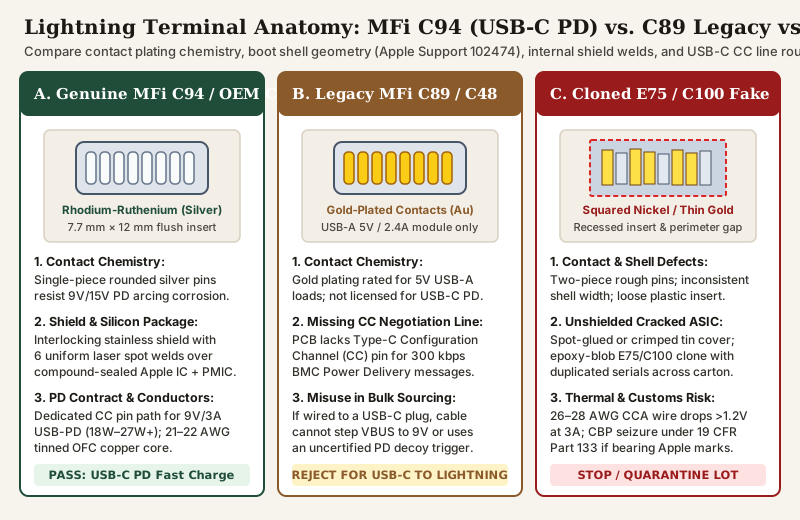
Why Genuine C94 / C91 Terminals Use Silver Rhodium-Ruthenium Contacts Instead of Gold
A critical physical check on any usb-c cable to lightning is the plating color of the eight contact pins on the Lightning tongue:
- Silver-colored Rhodium-Ruthenium Plating (
C94andC91): When Apple introduced USB-C Power Delivery fast charging (9Vand15Vrails up to3A), higher voltage potential across the exposed Lightning pins accelerated electrochemical corrosion and micro-arcing blackening on older gold-plated contacts when exposed to sweat or humidity. Apple engineered theC94(third-party MFi USB-C PD) andC91(Apple OEM USB-C PD) terminals with inert rhodium-ruthenium (Rh-Ru) plating, which has a bright, uniform silver-white metallic appearance. - Gold-tinted Contacts (
C89/C48or Counterfeit): Apple’sC89andC48terminals use gold-plated pins and are restricted exclusively to USB-A to Lightning cables (5V / 2.4Amaximum). If a supplier delivers a USB-C to Lightning cable whose Lightning pins appear gold or brass-colored, the factory has either spliced an unauthorized USB-A terminal onto a USB-C cord or used a counterfeit connector tongue.
Four Mechanical Checks from Apple Support 102474 + Internal Shield Teardown
- Contact Pin Profile: Genuine
C94/C91pins are milled as a single-piece, smooth, rounded contact surface flush with the surrounding insulator. Counterfeit connectors use stamped two-piece pins with visible step edges, rough plating, squared corners, or uneven pin heights that snag the iPhone receptacle springs. - Lightning Boot Dimensions (
7.7 mm × 12 mm): Genuine Apple Lightning connector boots measure a uniform7.7 mmthickness by12 mmwidth with crisp symmetry. Counterfeit shells vary in width, taper unevenly, or exhibit mold flash along the parting line. - Faceplate Insert Alignment: Around the base of the metal Lightning tongue, genuine connectors feature a smooth, uniform grey/metallic faceplate insert seated completely flush with the outer housing. Counterfeit plugs show a recessed white or crooked grey plastic insert with a visible perimeter gap.
- Apple OEM Jacket Imprint and Internal Laser Welds: On first-party Apple cables,
"Designed by Apple in California"and"Assembled in China","Assembled in Vietnam", or"Indústria Brasileira"are laser-etched onto the TPE jacket approximately 7 inches (17.8 cm) from the USB connector, followed by a crisp 12-digit serial number. When your IQC engineer cuts open the overmold on 2 destructive teardown samples per lot, a genuineC94orC91module reveals a heavy interlocking stainless-steel ground shield secured by 6 symmetrical laser spot welds over a black epoxy-encapsulated Apple authentication ASIC and NXP/TI power management IC. Counterfeit cables use a folded tin cover held by friction tabs or glue over an unshielded PCB with a black epoxy blob (COB) cracked chip.
Rule of thumb: If any USB-C to Lightning sample exhibits gold-colored contact pins, a gap around the faceplate insert, or an internal metal shield without symmetrical laser spot welds → quarantine the entire lot immediately. Those physical traits never occur on factory-sealed Apple
C94orC91terminal modules.
Step 3: Run USB-PD Fast-Charge & MFi Terminal Protocol Readouts
Visual inspection catches crude mechanical fakes, but sophisticated counterfeiters polish nickel-plated pins to mimic rhodium-ruthenium and laser-etch fake serial numbers onto the jacket. Step 3 verifies the active silicon inside the Lightning head using an inline USB-PD and MFi protocol analyzer (such as a ChargerLAB POWER-Z KM003C, MF001, or FNIRSI FNB58).
According to Apple’s official iPhone fast-charging specification, iPhone 8 through iPhone 14 models require a USB-C to Lightning cable paired with an 18W, 20W, 29W, 30W, 35W, 61W, 67W, 87W, 96W, or 140W Apple USB-C Power Adapter—or a comparable third-party USB-C adapter supporting USB Power Delivery (USB-PD)—to charge up to 50% capacity in roughly 30 minutes. While iPhone 15 and later models transitioned to USB-C receptacles, refurbishers and enterprise buyers supporting the massive installed base of iPhone 8 through iPhone 14 devices rely on the C94 Lightning terminal to bridge USB-C Power Delivery to the Lightning port.
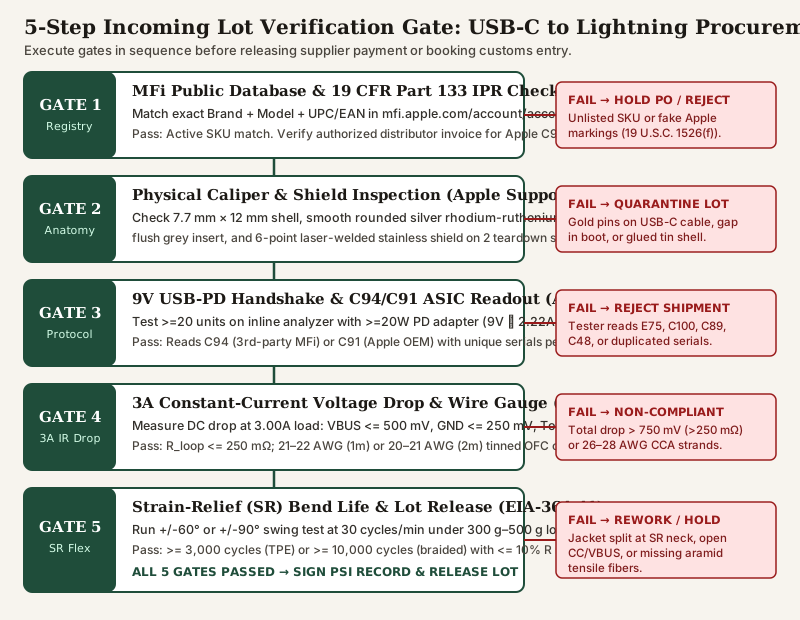
How USB-C CC Negotiation and Terminal ASIC Codes Work
In a genuine USB-C to Lightning cable, a dedicated Configuration Channel (CC) wire connects the USB-C plug’s CC pin directly to the Lightning C94 or C91 module. When plugged into a USB-PD wall adapter and an iPhone, the source and sink exchange Bi-phase Mark Coded (BMC) packets at 300 kbps over the CC line, while the iPhone performs cryptographic challenge-response authentication with the cable’s Apple ASIC over the Lightning ID0/ID1 pin. Only after both handshakes succeed does the adapter step VBUS up from 5.0V to a 9.0V fixed PDO (9V ⎓ 2.22A for 20W adapters, or up to 9V ⎓ 3.00A = 27W peak on iPhone 13 Pro Max / 14 Pro Max).
Scroll horizontally to see all columns.
| Terminal Code Readout | Intended Cable Type | Contact Plating | USB-PD 9V BMC Handshake | Serial Uniqueness Across Carton | Procurement Disposition for USB-C to Lightning PO |
|---|---|---|---|---|---|
| C94 | Licensed Third-Party MFi USB-C to Lightning | Rhodium-Ruthenium (Silver) | Yes (5V, 9V, 15V PDOs up to 3A) |
Unique factory-provisioned serial per cable | PASS (Verify SKU in MFi public database) |
| C91 | First-Party Apple OEM USB-C to Lightning | Rhodium-Ruthenium (Silver) | Yes (5V, 9V, 15V PDOs up to 3A) |
Unique 12-digit serial matching jacket print | PASS only with authorized Apple distributor invoice; REJECT if grey-market |
| C89 / C48 | Legacy MFi USB-A to Lightning Only | Gold-plated (Au) |
No (lacks Type-C CC line; 5V / 2.4A max) |
Unique or recycled from salvaged cords | REJECT (Unauthorized for USB-C to Lightning; cannot fast-charge or uses fake PD trigger) |
| E75 / C100 | Uncertified Cloned / Cracked ASIC | Thin Gold or Nickel | Fake (uses separate uncertified PD decoy IC) | Identical cloned serial repeated across carton | REJECT & QUARANTINE (Fails after iOS updates; overheating and fire hazard) |
When testing a minimum of 20 random cables per carton on an inline analyzer:
- Verify
9.0VPD Contract Step-Up: Connect the cable between a known-good 20W+ USB-PD adapter and a discharged iPhone (battery< 50%). Confirm thatVBUSsteps smoothly from5.0Vto9.0Vwithin 2 seconds and draws1.8A–2.9Awithout rebooting or cycling. - Verify Terminal ASIC Type (
C94vs.E75/C100): Run the tester’s Lightning terminal diagnostic. Any usb-c cable to lightning that reportsE75,C100,C48, orC89—or displays a"Score < 100 / Cracked Chip"flag—is a counterfeit assembly. - Check for Cloned Serial Duplication: Record the 12-character electronic serial number reported by the ASIC across at least 10 cables from the same master carton. Genuine
C94modules have individually serialized cryptographic IDs; clonedE75/C100chips flash the exact same copied serial string across thousands of units.
Takeaway: Test at least 20 units per lot on an inline protocol analyzer; reject any shipment where the ASIC reads as E75, C100, C89, or C48, or where two cables report the same electronic serial number.
Step 4: Measure 3A Load IR Voltage Drop (≤ 750 mV / ≤ 250 mΩ) and Conductor Gauge
Even when a cable negotiates a 9V contract at idle, counterfeit and cut-rate factories shave unit cost by replacing thick oxygen-free copper (OFC) power cores with thin 26–28 AWG copper-clad aluminum (CCA) or copper-clad steel (CCS). Under USB-IF Type-C Cable and Connector Specification compliance requirements, every USB-C cable assembly rated for 3.0A must keep its maximum DC IR voltage drop within strict ceilings:
- Maximum
VBUSpath voltage drop at3.0A:V_drop(VBUS) ≤ 500 mV(R_VBUS ≤ 166.7 mΩ) - Maximum
GNDreturn path voltage drop at3.0A:V_drop(GND) ≤ 250 mV(R_GND ≤ 83.3 mΩ) - Maximum Total Round-Trip Loop Voltage Drop at
3.0A:V_drop(total) ≤ 750 mV(R_loop ≤ 250 mΩ, including both connector contact resistances)
Engineering Equations and Worked Examples for 3A Load Testing
To evaluate a sample cable using a 4-wire Kelvin milliohmmeter or a 9.00V USB-PD source connected to a 3.00A constant-current electronic load, apply three equations:
- Total Round-Trip Loop Resistance (
R_loop):R_loop = R_VBUS + R_GND + R_contacts - Total Cable IR Voltage Drop at Rated Load (
V_drop):V_drop = I_load × R_loop - Delivered Sink Voltage at the iPhone Lightning Port (
V_sink) & Cable Heat Dissipation (P_loss):V_sink = V_source − V_dropP_loss = I_load² × R_loop
Compare two concrete 1-meter cable samples under a 9.00V / 3.00A (27W) fast-charge load:
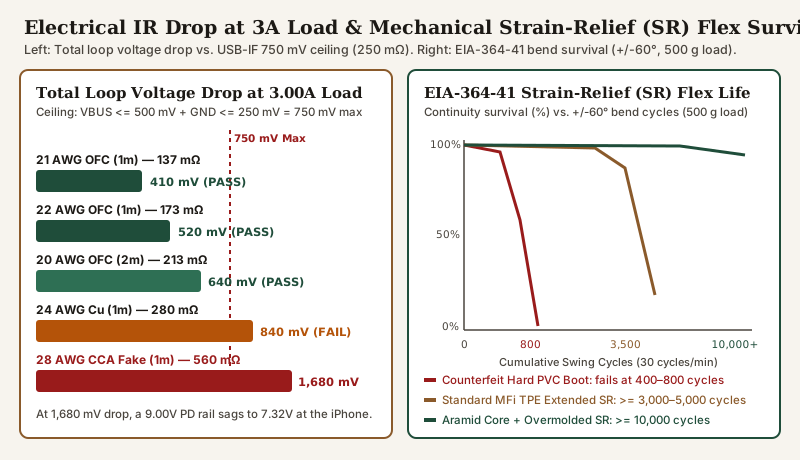
- Worked Example A — Genuine 1m MFi C94 Cable (
21 AWGTinned OFC Copper):- Measured round-trip loop resistance:
R_loop = 137 mΩ(0.137 Ω) - Total voltage drop at
3.00A:V_drop = 3.00 A × 0.137 Ω = 0.411 V(411 mV ≤ 750 mV→ PASS) - Delivered voltage at iPhone input:
V_sink = 9.00 V − 0.411 V = 8.59 V(safely within9VPD sink tolerance) - Cable thermal dissipation:
P_loss = (3.00 A)² × 0.137 Ω = 1.23 Wdistributed across 1 meter.
- Measured round-trip loop resistance:
- Worked Example B — Counterfeit 1m Cable (
28 AWGCopper-Clad Aluminum):- Measured round-trip loop resistance:
R_loop = 560 mΩ(0.560 Ω) - Total voltage drop at
3.00A:V_drop = 3.00 A × 0.560 Ω = 1.680 V(1,680 mV > 750 mV→ CRITICAL FAIL) - Delivered voltage at iPhone input:
V_sink = 9.00 V − 1.680 V = 7.32 V(crashes below the iPhone PMIC under-voltage threshold, causing repeated charge disconnects) - Cable thermal dissipation:
P_loss = (3.00 A)² × 0.560 Ω = 5.04 Wof waste heat, driving connector temperatures above65 °Cand softening the plastic boot.
- Measured round-trip loop resistance:
Scroll horizontally to see all columns.
| Cable Length & Power Core Gauge | Conductor Material | Typical Loop Resistance (R_loop) |
Total IR Drop at 3.00A (V_drop) |
Delivered V_sink (from 9.00V Source) |
Cable Heat Loss at 3.00A (P_loss) |
USB-IF 750 mV Ceiling Status |
|---|---|---|---|---|---|---|
1.0 m — 21 AWG (VBUS/GND) |
Tinned OFC Copper | 130–145 mΩ |
390–435 mV |
8.57–8.61 V |
1.17–1.31 W |
PASS (Premium MFi C94 1m spec) |
1.0 m — 22 AWG (VBUS/GND) |
Tinned OFC Copper | 165–185 mΩ |
495–555 mV |
8.45–8.51 V |
1.49–1.67 W |
PASS (Standard MFi C94 1m spec) |
2.0 m — 20 AWG (VBUS/GND) |
Tinned OFC Copper | 205–225 mΩ |
615–675 mV |
8.33–8.39 V |
1.85–2.03 W |
PASS (Required step-up for 2m length) |
1.0 m — 24 AWG (VBUS/GND) |
Bare Copper | 275–310 mΩ |
825–930 mV |
8.07–8.18 V |
2.48–2.79 W |
FAIL (Exceeds 750 mV / 250 mΩ limit) |
1.0 m — 28 AWG (VBUS/GND) |
Copper-Clad Aluminum (CCA) | 520–650 mΩ |
1,560–1,950 mV |
7.05–7.44 V |
4.68–5.85 W |
CRITICAL FAIL (PD drop-out & thermal hazard) |
When stripping the jacket on your 2 destructive teardown units, verify that the VBUS and GND conductors are silver-tinned oxygen-free copper strands (scrape a strand with a blade: pure tinned copper shows uniform red-orange copper underneath, whereas CCA exposes a silvery-white aluminum core that snaps after 2–3 sharp bends) wrapped in aluminum Mylar foil plus a ≥ 85% coverage tinned copper braided EMI shield.
Step 5: Audit Strain-Relief (SR) Bend-Cycle Life and Jacket Construction (EIA-364-41)
In B2B accessory distribution and phone refurbishment programs, the single largest mechanical warranty failure mode is conductor breakage at the strain-relief (SR) neck directly behind the Lightning plug. Even a genuine C94 module will generate field returns within 60 days if the factory molds a short, rigid PVC collar without internal tensile anchoring.
To prevent early fatigue failures, specify and verify mechanical flex testing under EIA-364-41 (Circular Jacket Cable Flexing Test Procedure for Electrical Connectors):
- Fixture & Bend Angle: Clamp the Lightning plug in a oscillating chuck that bends the cable neck through
±60°(or±90°for ruggedized SKUs) across a mandated mandrel radius at30 cycles per minute. - Suspended Tension Load: Hang a
300 g(standard 1m TPE cord) or500 g(reinforced braided cord) deadweight from the vertical cable section to simulate real-world pull stress while charging a handset in hand. - Pass/Fail Acceptance Thresholds:
- Standard TPE Jacket MFi C94 SKU: Must complete
≥ 3,000to5,000cycles without outer jacket splitting, shield protrusion, open-circuit interruption onVBUS,GND,D+,D-, orCC, or a loop resistance increase exceeding10%. - Reinforced Nylon-Braided or Liquid-Silicone SKU: Must complete
≥ 10,000cycles under identical electrical continuity monitoring.
- Standard TPE Jacket MFi C94 SKU: Must complete
- Internal Tensile Yarn Verification: During your 2-unit teardown, verify that the cable core includes 250D–500D Kevlar/aramid tensile yarn running continuously alongside the insulated wires and mechanically crimped into the metal strain-relief ferrule, so pulling on the cord loads the aramid fiber rather than the solder pads on the
C94PCB.
Keep the Lot Verification Record & Attach It to Your Purchase Order
Treat these five gates as a single release package before approving supplier payment or booking freight. Copy the blank USB-C to Lightning C94 lot inspection checklist into your order folder and attach five pieces of transaction-specific evidence to every PO:
- MFi Registry Screenshot & Date: The exact Brand, Model Number, and UPC/EAN match captured from Apple’s MFi Licensed Accessories search.
- Caliper & Teardown Photographs: Macro photos of the silver rhodium-ruthenium contact pins,
7.7 mm × 12 mmshell measurement, and the decapsulated 6-point laser-welded stainless shield per Apple Support 102474. - Protocol Tester Log (
≥ 20units): Inline tester screenshots confirming9.0VUSB-PD negotiation,C94(or authorizedC91) ASIC identification, and non-duplicated serial numbers. - 3A Load Voltage Drop Log (
≥ 10units): RecordedV_drop(≤ 750 mV) andR_loop(≤ 250 mΩ) measurements at3.00ADC, plus strand gauge verification (21–22 AWGOFC on 1m cords). - EIA-364-41 Flex Test Report (
3–5units): Cycle count (≥ 3,000or≥ 10,000cycles), swing angle, load weight, and post-test resistance reading.
When comparing unit quotes across competing factories, use the total-cost guide to model how a $0.65 unit savings on an uncertified E75 cable turns into a net loss once RMA replacements, marketplace account suspensions, or customs seizures are priced in. Additional component and procurement worksheets are indexed in the articles directory.
Frequently Asked Questions
How can I tell if a USB-C cable to Lightning has a genuine MFi C94 chip vs. a cloned E75 chip?
Combine three checks: first, confirm the exact Brand, Model Number, and retail UPC/EAN barcode in Apple’s public MFi Licensed Accessories database; second, inspect the eight Lightning contact pins under a loupe to confirm smooth, single-piece, silver-colored rhodium-ruthenium plating (C94/C91) rather than gold plating (C89/C48 USB-A only) or rough nickel; third, plug at least 20 samples into an inline MFi/PD protocol analyzer (such as a ChargerLAB POWER-Z KM003C or MF001) to verify that each unit negotiates a 9V USB-PD contract, reports terminal code C94 (or C91 on genuine Apple OEM cords), and displays a unique serial number rather than a cloned E75 or C100 readout.
Why do genuine USB-C to Lightning cables have silver pins instead of gold pins?
Apple upgraded the contact metallurgy from gold plating (C48/C89 USB-A terminals) to rhodium-ruthenium (Rh-Ru) silver-colored plating on C94 and C91 USB-C to Lightning terminals because USB Power Delivery steps charging voltage up from 5V to 9V and 15V at up to 3A. Under higher PD voltages, exposed gold contacts suffer accelerated electrochemical corrosion and micro-arcing pitting when exposed to moisture or skin oils, whereas rhodium-ruthenium provides a harder, corrosion-resistant surface.
What is the maximum allowable voltage drop on a USB-C to Lightning cable at 3A load?
Following the USB-IF Type-C Cable and Connector Specification, a 3A cable assembly must limit DC IR voltage drop to ≤ 500 mV on the VBUS conductor and ≤ 250 mV on the GND return conductor, yielding a maximum total round-trip loop drop of ≤ 750 mV at 3.00A (equivalent to a total loop resistance R_loop ≤ 250 mΩ). Meeting this ceiling requires 21–22 AWG tinned oxygen-free copper (OFC) power cores on a 1m cable and 20–21 AWG OFC on a 2m cable.
Can U.S. Customs seize bulk “original iPhone charger” cables imported from overseas wholesalers?
Yes. Under 19 CFR Part 133 Subpart C, U.S. Customs and Border Protection (CBP) detains, seizes, and forfeits imported merchandise bearing counterfeit or unauthorized recorded trademarks, including "Designed by Apple in California" cable imprints, Apple logos, or unauthorized MFi logos. Under 19 U.S.C. 1526(f), the importer of record also faces civil penalties up to the domestic retail value of genuine Apple products for a first seizure, even if the supplier invoiced the goods as “original OEM factory stock.”
Sources
- Apple Support, Identify counterfeit or uncertified Lightning connector accessories. Physical inspection benchmarks for Lightning contact pins,
7.7 mm × 12 mmshell dimensions, flush grey/metallic faceplate insert, and 7-inch jacket markings on Apple-manufactured cables. - Apple Inc., MFi Licensed Accessories — Public Database Search. Official public registry for verifying certified third-party MFi accessories by Brand, Model Number, and UPC/EAN barcode.
- Apple Inc., Apple MFi Program Licensing Overview. Authorized component distribution and licensing structure for MFi hardware authentication connectors (
C94for third-party USB-C to Lightning PD vs.C91OEM andC89USB-A). - Apple Support, Fast charge your iPhone. USB-C to Lightning cable and ≥18W/20W USB Power Delivery adapter requirements for fast-charging iPhone 8 through iPhone 14 models.
- Apple Support, Charge and connect with the USB-C connector on your iPhone 15 or later. Transition from Lightning to USB-C starting with the iPhone 15 series and connector separation across device generations.
- USB Implementers Forum (USB-IF), Cables and Connectors Compliance & Type-C Requirements. Maximum DC IR voltage drop limits (
≤ 500 mVonVBUS,≤ 250 mVonGND,≤ 750 mVtotal loop drop at3A/≤ 250 mΩ), captive/non-USB connector rules, andEIA-364-41mechanical flex test references. - USB Implementers Forum (USB-IF), USB Charger (USB Power Delivery) Specification. USB-PD fixed PDO voltage contracts (
5V,9V,15V,20V) negotiated via Bi-phase Mark Coding (BMC) over the Type-C Configuration Channel (CC) wire. - U.S. Code of Federal Regulations, 19 CFR Part 133 — Trademarks, Trade Names, and Copyrights. U.S. Customs and Border Protection detention, seizure, forfeiture, and
19 U.S.C. 1526(f)civil penalty authority over counterfeit trademarked electronics imports.
Sources checked
Related articles
What Unlocked Phones Work With Verizon?
Check an unlocked phone for Verizon using its exact model, private IMEI, carrier-lock status and SIM or eSIM requirements.
Read article Is a Samsung Charger Original?
Record the seller claim, the printed label, the order, and a Samsung reply. A printed label is not a confirmed identity.
Read article
How to Verify an Electronics Supplier
Check an electronics supplier's identity, authorization, stock, payment details and warranty with an evidence worksheet and a worked buying scenario.
Read article