
Authorized Distributors vs. Component Brokers: ECIA, CoC & IC Lab Tests
Compare franchised distributors (Mouser Electronics, DigiKey, Arrow) with open-market brokers to prevent counterfeit IC failures: verify SAE AS6496 CoC, MSL 3, and AS6171.
AI-assisted research. Editorial responsibility: ElectronicSeek Editorial Desk; see our editorial methodology. How this guide was prepared
Buying allocated semiconductors or passive components from unvetted open-market electronics suppliers without verifying Original Component Manufacturer (OCM) chain-of-custody records causes costly surface-mount technology (SMT) line stops, 260 °C reflow package delaminations, and field recalls when brokers deliver sanded, blacktopped, or e-waste salvaged integrated circuits (ICs). Before releasing a purchase order or accepting a shortage lot, confirm the distributor’s franchise status through the Electronic Components Industry Association (ECIA), reconcile the OCM Certificate of Conformance (CoC) lot and date codes under SAE AS6496, inspect IPC/JEDEC J-STD-033D moisture barrier bags, and subject any non-franchised broker lot to a 4-stage SAE AS6171 laboratory test protocol.
Franchised catalog distributors such as Mouser Electronics and DigiKey Electronics—alongside broadline volume distributors Arrow Electronics, Avnet, Future Electronics, and TTI—purchase 100% of their stock directly from Original Component Manufacturers under SAE AS6496 chain-of-custody controls. Independent brokers buy secondary excess without factory warranty or OCM lot traceability, requiring mandatory IDEA-STD-1010-B visual microscopy, heated solvent remarking tests, XRF/X-ray inspection, and acid decapsulation before SMT assembly.
This component verification guide connects to the sourcing and verification hub and the electronics suppliers shortlist directory. For general trade definitions across retail and wholesale commerce, see distributor vs wholesaler vs reseller and the wholesale electronics buying channels guide. Before onboarding any new vendor entity, complete the corporate registry and bank beneficiary checks in how to evaluate a supplier, lock exact part suffixes using the specification comparison guide, and enforce lot quarantine milestones from the first-order risk checklist. When your bill of materials includes licensed Apple fast-charging connectors procured through authorized channels, pair this workflow with the USB-C to Lightning MFi C94 authenticity check.
Scroll horizontally to see all columns.
| Procurement Dimension | Tier 1 Franchised Catalog Distributors (Mouser Electronics, DigiKey Electronics) |
Tier 1 Franchised Broadline / Volume Distributors (Arrow, Avnet, Future, TTI) |
Tier 3 Non-Authorized Open-Market Brokers & Spot Resellers |
|---|---|---|---|
| OCM Contractual Status & ECIA Verification | Direct franchise contract with 1,200+ OCMs; verified on ECIA / TrustedParts.com; zero open-market buying |
Direct franchise contract with core OCMs; verified on ECIA; dedicated factory allocation & bonded inventory programs | Zero OCM franchise contract; buys OEM/EMS excess, aged regional stock, or open-market spot lots (48 CFR Subpart 246.8 Cat 3) |
| Anti-Counterfeit & Quality Accreditation | SAE AS6496, AS9100D, ISO 9001:2015, and ANSI/ESD S20.20 certified |
SAE AS6496, AS9100D, ISO 9001:2015, ISO/TS 16949 / IATF 16949 automotive supply support, ANSI/ESD S20.20 |
Frequently unaccredited or ISO 9001 only; advanced brokers hold SAE AS6081 but still require lot-by-lot SAE AS6171 lab testing |
Certificate of Conformance (CoC) & Traceability |
Direct OCM 1P (MPN), 1T (Wafer/Assembly Lot), 9D (YYWW Date Code), and 4L (COO) backed by OCM shipment records |
Full OCM Factory CoC + wafer/assembly lot traceability + Automotive PPAP (AEC-Q100/Q200) documentation |
Broker self-issued packing-slip “CoC” only; upstream supplier names redacted; zero unbroken chain of custody to OCM fab |
Moisture (J-STD-033D) & ESD (S20.20) Handling |
Vacuum-sealed MIL-PRF-81705 Type I MBB, active desiccant, cobalt-free HIC (< 10% RH), and logged cut-tape floor-life clock |
Factory-sealed OCM master reels, matrix trays, and tubes in unopened IPC/JEDEC J-STD-033D dry-packs |
Frequently opened or punctured MBBs, pink/saturated HIC cards (> 10%–60% RH), spliced EIA-481 carrier tape, or pink poly bags |
| Primary Order Profile & Lead-Time Role | NPI engineering prototypes, cut-tape, and small-to-medium production reels (1 to 10,000+ units) with immediate dispatch |
High-volume scheduled production contracts, Field Application Engineer (FAE) design-in registration, and scheduled reels |
Last-resort shortage, allocation, or End-of-Life (EOL / obsolete) bridge buys only under formal SAE AS5553D risk mitigation |
OCM Factory Warranty & Failure Analysis (FA) |
Full OCM warranty + access to OCM root-cause 8D Failure Analysis laboratories |
Full OCM warranty + direct FAE escalation and OCM 8D silicon-level Failure Analysis |
Voided OCM warranty; limited 30–90 day broker replacement only if buyer funds an independent SAE AS6171 test lab report |
Download the component distributor CoC and AS6171 incoming inspection checklist and attach it to your purchase order or incoming quality control (IQC) router to record documentary, dry-pack, and laboratory verification results for each lot.
Step 1: Verify ECIA Franchise Status and Audit the Manufacturer Certificate of Conformance (SAE AS6496)
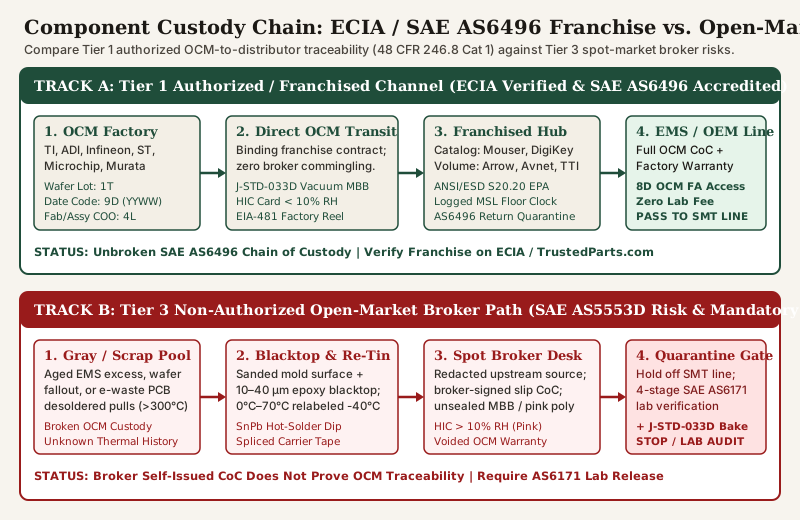
In semiconductor and passive component procurement, the word “distributor” on a company website does not establish manufacturer authorization. Under the supply-chain hierarchy codified in 48 CFR Subpart 246.8 (DFARS 252.246-7007 and 252.246-7008) and SAE AS5553D (Counterfeit Electronic Parts; Avoidance, Detection, Mitigation, and Disposition), electronic component sources divide into strictly separated risk tiers:
- Category 1 — Original Component Manufacturers (
OCMs) and Authorized/Franchised Distributors: Organizations such asMouser Electronics,DigiKey Electronics,Arrow Electronics,Avnet,Future Electronics, andTTIoperate under binding contractual franchise agreements with OCMs (including Texas Instruments, Analog Devices, Infineon, STMicroelectronics, Microchip, Murata, and Vishay). Governed bySAE AS6496(Fraudulent/Counterfeit Electronic Parts: Avoidance, Detection, Mitigation, and Disposition — Authorized/Franchised Distribution), these distributors procure 100% of their inventory directly from the OCM factory and never buy from independent brokers or open-market resellers. - Category 3 — Non-Authorized Independent Brokers and Spot-Market Resellers: Independent brokers hold no franchise contract for the part being quoted. They aggregate surplus inventory from contract manufacturers (
EMSexcess), regional trading desks, or secondary spot markets. Under48 CFR 246.8andSAE AS5553D, purchasing from an independent broker is an exception path allowed only when a component is unavailable from any OCM or franchised distributor, and it mandates formal risk assessment, customer notification, and authenticated laboratory inspection underSAE AS6171.
How to Confirm Franchise Authorization via ECIA and TrustedParts
Before issuing a purchase order to any supplier claiming to be an authorized distributor for a semiconductor or passive brand, verify the relationship through two primary industry registries:
- The OCM’s Official “Authorized Distributors / Order Direct” Directory: Query the component manufacturer’s own domain (for example,
ti.com,analog.com,infineon.com, orst.com) to confirm that the exact legal entity and regional branch are listed as a franchised partner for your territory. - The Electronic Components Industry Association (ECIA) Roster and
TrustedParts.com: ECIA is the North American and global trade association uniting OCMs and their contractually franchised distributors. ECIA operatesTrustedParts.com, an inventory aggregation search engine restricted exclusively to OCMs and ECIA-verified authorized distributors. Searching a Manufacturer Part Number (MPN) onTrustedParts.comreturns live stock, reel multiples, and factory lead times solely from franchised channels (Mouser Electronics,DigiKey Electronics,Arrow,Avnet,TTI,Newark/Farnell,RS,Rutronik,Master Electronics, andHeilind), filtering out gray-market broker listings.
Line-by-Line Audit of an OCM / SAE AS6496 Certificate of Conformance (CoC)
A frequent procurement failure occurs when a buyer accepts a broker’s self-issued “Certificate of Conformance” as proof of authenticity. As 48 CFR Subpart 246.8 emphasizes, a broker-signed CoC only certifies that the shipment matches the broker’s own packing slip; because brokers redact upstream supplier names to protect their trading margin, a broker CoC provides zero traceability to the OCM production lot.
When receiving a shipment from Mouser Electronics, DigiKey Electronics, or a broadline franchised distributor under SAE AS6496, reconcile the distributor’s CoC and the outer reel/tray 2D DataMatrix or PDF417 barcode label against the following standardized ANSI/MH10.8.2 / ECIA data identifiers:
1P— Exact Manufacturer Part Number (MPN): Must match the complete ordering string on your engineering BOM, including temperature grade (I=-40 °C to +85 °C,Q/E=-40 °C to +125 °Cautomotive), package code, lead finish (NOPB/G/Zfor RoHS Matte Sn or NiPdAu), and tape-and-reel suffix (TR/R7).1T— OCM Traceability / Wafer & Assembly Lot Number: The alphanumeric factory batch code linking the reel directly to the OCM’s wafer fabrication diffusion run and backend assembly/test lot.9D— 4-Digit Date Code (YYWW): Indicates the year and calendar week of manufacture or package seal (for example,2542= Week 42 of 2025). Verify that the date code printed on the outer MBB label matches the inner reel hub label and the laser marking on the IC body.Q— Exact Quantity: Unit count inside the sealed carrier tape or matrix tray.4L— Country of Origin (COO): Two-letterISO 3166-1country code recording where backend assembly/test and wafer diffusion occurred (e.g.,MYMalaysia,PHPhilippines,TWTaiwan,USUnited States).SAE AS6496Anti-Commingling Return Policy: UnderSAE AS6496, franchised distributors quarantine customer returns and never restock returned parts into saleable inventory unless the original OCM factory tamper-evident seal is verified unbroken under strict quality audit.
Takeaway: A valid component CoC must carry SAE AS6496 distributor traceability (1P MPN, 1T OCM lot code, 9D YYWW date code, and 4L Country of Origin) backed by an ECIA-verified franchise contract; treat any broker-signed CoC or redacted invoice as unverified Tier 3 stock.
Step 2: Inspect Moisture Barrier Bags (IPC/JEDEC J-STD-033D), HIC Cards, and ANSI/ESD S20.20 Packaging
Even when a semiconductor die is 100% genuine OCM silicon, improper warehouse humidity or electrostatic discharge (ESD) handling destroys component reliability before the reel ever reaches the pick-and-place machine. Plastic encapsulated microcircuits (PEMs—such as LQFP, TQFP, QFN, BGA, and SOIC packages) mold hygroscopic epoxy resin around a copper leadframe or organic substrate. When exposed to ambient warehouse air, moisture diffuses through the epoxy mold compound and collects at the internal interface between the silicon die, die-attach epoxy, and copper paddle.
According to Analog Devices’ quality and reliability guidelines for IPC/JEDEC J-STD-020 and J-STD-033D, modern lead-free (SAC305 Sn96.5/Ag3.0/Cu0.5) surface-mount reflow subjects packages to peak body temperatures of 245 °C to 260 °C. If moisture trapped inside an unsealed MSL 3 or MSL 4 IC flashes into superheated steam during the 260 °C reflow spike, internal vapor pressure expands rapidly—causing internal die-paddle delamination, bond-wire shear, and visible “popcorn” package cracking.
Auditing the 4-Element IPC/JEDEC J-STD-033D Dry-Pack System at Receiving
When an MSL 2 through MSL 5a component lot arrives on your receiving dock, inspect four physical dry-pack elements before logging the lot into inventory:
- Aluminized Moisture Barrier Bag (
MBB,MIL-PRF-81705 Type I): The bag must be metallized, opaque, puncture-free, and tightly vacuum-sealed with an unbroken heat seal. - Active Desiccant Pouches: Sealed inside the MBB alongside the reel or tray to absorb residual water vapor per
MIL-D-3464. - Cobalt-Dichloride-Free Humidity Indicator Card (
HIC): Features three chemical indicator spots calibrated at5%,10%, and60%Relative Humidity (RH) that shift color from dry blue (or brown/green on certain cobalt-free cards) to wet pink/lavender as humidity rises. - Exterior Caution Label & Floor-Life Clock: States the package’s exact Moisture Sensitivity Level (
MSL), peak reflow temperature (260 °C), bag seal date, and maximum allowable ambient floor life at≤ 30 °C / 60% RH.
Scroll horizontally to see all columns.
MSL Rating (J-STD-020) |
Max Ambient Floor Life (≤ 30 °C / 60% RH) |
Dry-Pack & HIC Requirement (J-STD-033D) |
Mandatory Action if HIC 10% Spot Turns Pink (> 10% RH) |
Recovery Bake (≤ 1.4 mm Body Thickness, J-STD-033D Table 4-1) |
|---|---|---|---|---|
| MSL 1 | Unlimited (≤ 30 °C / 85% RH) |
Dry-pack not required (ANSI/ESD S541 shielding bag required) |
Inspect for water condensation or lead oxidation | Not required unless submerged or oxidized |
| MSL 2 | 1 year (365 days) |
Vacuum MBB + desiccant + HIC (< 60% RH) |
If 60% spot is pink, floor life is expired; bake before reflow |
125 °C for 4 hours (high-temp tray) or 40 °C / ≤ 5% RH for 5 days (120 h) |
| MSL 2a | 4 weeks (672 hours) |
Vacuum MBB + desiccant + HIC (< 10% RH at seal) |
If 10% spot is pink and 60% is blue, verify exposure; bake if 60% is pink |
125 °C for 5 hours (high-temp tray) or 40 °C / ≤ 5% RH for 5 days (120 h) |
| MSL 3 | 168 hours (7 days) |
Vacuum MBB + desiccant + HIC reading < 10% RH |
Hold from SMT line; floor-life clock compromised → mandatory recovery bake | 125 °C for 9 hours (1.4 mm) to 24–48 h (2.0–4.5 mm), or 40 °C / ≤ 5% RH for 8 days (192 h) in carrier tape |
| MSL 4 | 72 hours (3 days) |
Vacuum MBB + desiccant + HIC reading < 10% RH |
Hold from SMT line; mandatory recovery bake before 260 °C reflow |
125 °C for 11 hours (1.4 mm) to 32–48 h (2.0–4.5 mm), or 40 °C / ≤ 5% RH for 10 days (240 h) in carrier tape |
| MSL 5 / 5a | 48 hours / 24 hours |
Vacuum MBB + desiccant + HIC reading < 10% RH (< 5% RH for 5a) |
Hold from SMT line; mandatory recovery bake before 260 °C reflow |
125 °C for 14–16 hours (1.4 mm) to 48 h (> 2.0 mm), or 40 °C / ≤ 5% RH for 13–14 days |
| MSL 6 | Mandatory Bake Before Use | Shipped with caution label; must be baked immediately prior to solder reflow | Bake every lot per time specified on label regardless of HIC | Bake per OCM label specification and reflow within Time on Label |
How Mouser Electronics and DigiKey Electronics Handle Cut-Tape MSL and ANSI/ESD S20.20 Controls
When engineering or low-volume production teams order 50 or 250 pieces of an MSL 3 microcontroller on cut tape from Mouser Electronics or DigiKey Electronics, the distributor opens a factory master MBB inside an automated, climate-controlled ANSI/ESD S20.20 Electrostatic Protected Area (EPA). Per the EOS/ESD Association ANSI/ESD S20.20 and ANSI/ESD S541 standards, operators work on grounded dissipative surfaces (10^4 to < 10^9 Ω resistance to ground) with continuous wrist-strap monitoring and ionization to prevent Human Body Model (HBM ≥ 100 V) and Charged Device Model (CDM ≥ 200 V) latent gate-oxide damage.
Crucially, Mouser Electronics and DigiKey Electronics log the exact timestamp when the master MSL 3 bag is opened, cut the continuous EIA-481 carrier tape, and immediately vacuum-seal both the customer’s cut-tape strip and the remaining master reel into fresh J-STD-033D Moisture Barrier Bags with new desiccant pouches, a fresh cobalt-free HIC card, and a printed floor-life tracking label.
To track remaining floor life (T_rem) across cut-tape handling and multi-pass SMT assembly at ≤ 30 °C / 60% RH, apply the J-STD-033D cumulative exposure equation:
T_rem = T_floor_max − Σ(t_ambient_i)
For an MSL 3 package (T_floor_max = 168 hours), if the distributor’s EPA unpacking and re-bagging consumes t_ambient_1 = 2 hours and your first SMT line setup exposes the reel for t_ambient_2 = 94 hours before re-sealing into a dry cabinet (≤ 5% RH) or fresh vacuum MBB, the remaining floor life before a mandatory recovery bake is:
T_rem = 168 hours − (2 hours + 94 hours) = 72 hours
In contrast, open-market brokers frequently store unsealed reels on ambient warehouse shelves for months or ship cut tape inside pink polyethylene (“pink poly”) bags. Pink poly bags are merely topical antistatic (low-tribocharging) film—they provide zero Faraday-cage electrostatic shielding (ANSI/ESD S541 requires metallized shielding bags with < 50 nJ discharge energy penetration) and zero moisture barrier protection. Furthermore, because standard polystyrene or polycarbonate EIA-481 carrier tape melts and warps above 60 °C, an unsealed broker reel cannot be baked at 125 °C unless every IC is manually unloaded into high-temperature aluminum matrix trays and re-reeled afterward—or baked in-reel at 40 °C / ≤ 5% RH for 192 hours (8 full days), stalling urgent production schedules.
Takeaway: Reject or quarantine for recovery baking any MSL 3+ semiconductor reel whose Moisture Barrier Bag is unsealed, whose HIC 10% spot has turned pink, or that arrives in a non-shielding pink poly bag.
Step 3: Classify Counterfeit & Substandard IC Failure Modes in Open-Market Broker Lots (SAE AS5553D)
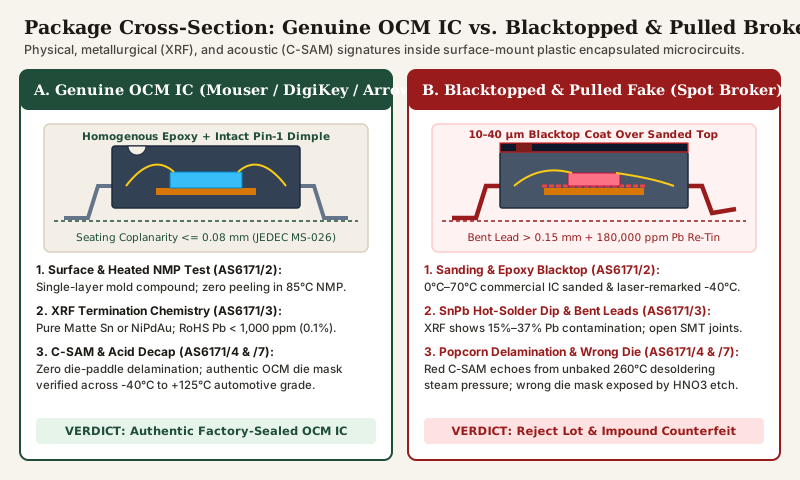
When global wafer allocation or component obsolescence (EOL) forces a purchasing team to evaluate a Tier 3 independent broker quote, your incoming quality engineers must know exactly what physical alterations occur in gray-market channels. SAE AS5553D classifies fraudulent and counterfeit electronic parts into seven distinct categories: Recycled (Pulled), Remarked (Blacktopped), Overproduced, Out-of-Spec/Defective, Cloned, Forged Documentation, and Tampered. Across EMS incoming inspection laboratories, three physical failure mechanisms account for the vast majority of line-stopping broker defects:
1. Remarked / “Blacktopped” Speed and Temperature Grade Upgrades
A semiconductor family often shares the exact same plastic package outline (LQFP-64 or QFN-48) across multiple price tiers, separated only by suffix codes:
- Commercial Grade (
0 °C to +70 °C): Lowest cost, screened only at room/commercial temperatures. - Industrial Grade (
-40 °C to +85 °C): Mid-tier pricing. - Automotive
AEC-Q100 Grade 1(-40 °C to +125 °C) or Military (-55 °C to +125 °C): Premium pricing, subjected to wafer-level burn-in and three-temperature ATE testing.
During shortages of Industrial or Automotive AEC-Q100 parts, counterfeiters purchase cheap Commercial-grade (0 °C to +70 °C) or obsolete date-code (2015–2018) reels, mechanically sand or micro-lap 50–100 µm off the top epoxy surface to erase the genuine OCM laser mark, apply a 10 µm to 40 µm cured thermoset epoxy “blacktop” coating doped with carbon black and silica filler to mimic original mold texture, and laser-etch the high-value Automotive suffix and a fresh 2026 date code. Because the silicon die inside is still an authentic OCM commercial die, the part passes room-temperature continuity and functional power-on tests at 25 °C, then suffers phase-locked loop (PLL) unlock, ADC reference drift, or latch-up when deployed in an industrial cabinet at -30 °C or an automotive engine bay at +115 °C.
2. E-Waste Pulled Components, SnPb Re-Tinning, and JEDEC MS-026 Coplanarity Failures
Recycled (“pulled”) ICs are harvested from scrapped printed circuit boards over unregulated open-flame heaters or sand baths exceeding 300 °C to 350 °C. This violent thermal and mechanical extraction creates three compounding defects:
- RoHS Lead (
Pb) Contamination via Hot-Solder Dipping: To hide dull, oxidized, or solder-crusted pins after desoldering, refurbishers dip the gull-wing leads into molten leaded eutectic solder (63Sn/37Pb) and mechanically comb the pins. While genuine RoHS-compliant terminations (Matte SnorNiPdAu) containPb < 1,000 ppm(0.1 wt%), re-tinned leads exhibit150,000 ppm to 370,000 ppm Pb(15%–37% Pb) under X-ray fluorescence (XRF). Beyond triggering legal non-compliance under EU RoHS Directive2011/65/EU, mixing leadedSnPbcomponent leads with lead-freeSAC305solder paste creates low-meltingSn-Pb-Agternary phases (179 °C) that fracture under thermal cycling. - Gull-Wing Lead Coplanarity Violations (
JEDEC MS-026): UnderJEDEC MS-026/JEP95package outlines for fine-pitchLQFPandTQFPpackages (0.4 mmto0.5 mmlead pitch), all gull-wing lead feet must lie within a≤ 0.08 mm(0.003 in.) seating-plane coplanarity window so every pin contacts the0.10 mm–0.12 mmstencil-printed solder paste deposit. Pulled and combed ICs routinely exhibit bent, twisted, or burred leads with0.12 mm to 0.25 mmcoplanarity deviation, causing open solder joints (“lifted pins”) that require manual hot-air touch-up across hundreds of assembled PCBAs. - Internal Thermal Delamination: Because pulled ICs were saturated with ambient moisture on scrap boards before being heated above
300 °Cduring removal, internal steam pressure delaminates the mold compound from the die surface and copper paddle, severing or weakening gold/copper Stitch bonds.
3. Cloned Silicon Dies, Wafer-Sort Scrap, and Spliced Reels
At the most aggressive end of the counterfeit spectrum, bad actors encapsulate unauthorized reverse-engineered clone dies (common in power MOSFETs, linear regulators, RS-485 transceivers, and op-amps) with 30%–60% smaller silicon die area—resulting in 2× to 4× higher drain-source on-resistance (R_DS(on)) and immediate thermal runaway under rated current—or splice 20 genuine ICs onto the leader end of an EIA-481 carrier tape reel followed by 980 dummy plastic packages or wafer-sort scrap rejects.
Rule of thumb: If any sample IC in a brokered lot exhibits a lead coplanarity deviation
> 0.08 mm, an XRF lead (Pb) reading> 1,000 ppmon a RoHS suffix, or mismatched bottom mold-cavity Country of Origin stamps within the same date-code reel → quarantine the entire lot immediately as salvaged/commingled stock.
Step 4: Execute the 4-Stage IDEA-STD-1010-B & SAE AS6171 Laboratory Test Protocol on Brokered Lots
Whenever a non-authorized broker lot is purchased—or when a supplier cannot provide an unbroken SAE AS6496 chain of custody to Mouser Electronics, DigiKey Electronics, Arrow, Avnet, Future, TTI, or the OCM—quarantine the shipment off the production floor and route a statistically valid sample through the 4-stage inspection sequence defined by IDEA-STD-1010-B (Acceptability of Electronic Components Distributed in the Open Market) and SAE AS6171 (Test Methods Standard; General Requirements, Suspect/Counterfeit, Electrical, Electronic, and Electromechanical Parts).
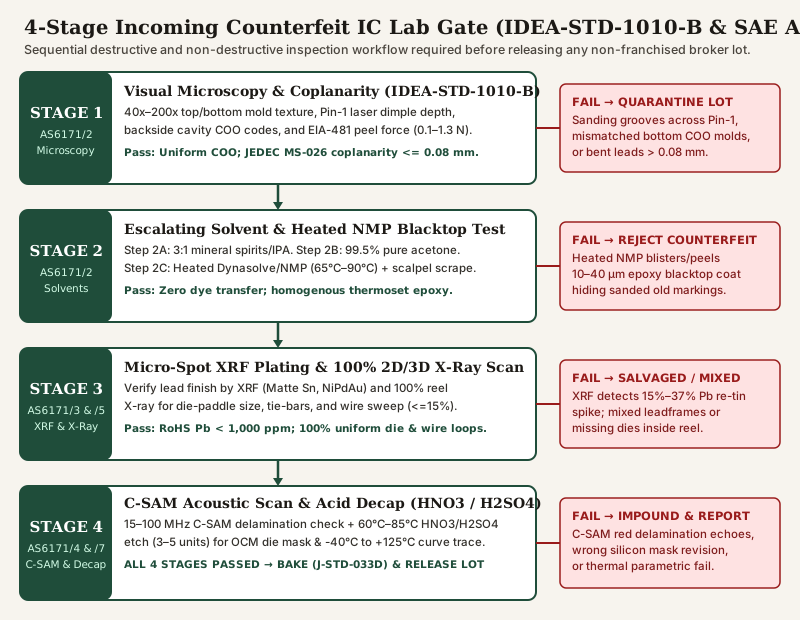
Stage 1: External Visual & Dimensional Microscopy (IDEA-STD-1010-B & SAE AS6171/2)
Inspect 20 to 45 sample units across the front, middle, and tail of every reel under a 40× to 200× stereo and coaxial digital microscope:
- Top Mold Texture & Pin-1 Dimple Inspection: Genuine OCM packages have a uniform matte or fine-grain mold compound surface across the top body and inside the recessed Pin-1 indentation. If parallel micro-grinding striations appear under angled darkfield lighting, if the Pin-1 dimple is anomalously shallow (
< 0.10 mm), or if the dimple floor texture differs from the top surface (or contains laser-etching marks inside the dimple), the package has been sanded and resurfaced. - Backside Ejector Pin & Mold Cavity Audit: Turn the IC over and record the bottom ejector pin indentations, mold cavity numbers, and stamped Country of Origin (
MALAYSIA,PHILIPPINES,CHN,TAIWAN). Within a single OCM assembly lot (1T) and date code (9D), backside mold geometry and Country of Origin must be consistent. Finding mixedCHNandMALAYSIAbackside cavities inside one single-lot reel proves the broker swept together loose scrap or excess tubes and re-taped them. - 3D Optical Lead Coplanarity (
JEDEC MS-026) &EIA-481Carrier Tape Check: Measure gull-wing foot coplanarity (≤ 0.08 mmmax), check for solder bridges or longitudinal comb scratches on lead tips, and testEIA-481cover-tape peel force (0.1 N to 1.3 N), rejecting any reel with heat-spliced or brass-shimmed carrier tape pockets.
Stage 2: Escalating Solvent Permanency & Blacktop Scrape Test (SAE AS6171/2)
A critical mistake in basic IQC shops is wiping an IC with isopropyl alcohol (IPA) or room-temperature acetone and declaring it authentic when no black ink rubs off. Under SAE AS6171/2, chemical remarking and resurfacing verification must follow a strict three-tier escalating solvent protocol:
- Step 2A —
3:1Mineral Spirits / Isopropyl Alcohol (IPA) Solution: Swabbed across the top marking for30 secondsto test basic OCM ink permanency and remove surface grime. - Step 2B — Pure
99.5%Acetone Swab: Dissolves uncured acrylic, lacquer, and basic one-part spray coatings. Technical caveat: Modern counterfeiters formulate two-part thermally cured epoxy blacktop layers that are cross-linked and completely impervious to room-temperature acetone. Stopping at acetone produces false passes on high-grade blacktopped ICs. - Step 2C — Heated Aggressive Solvent Immersion (
Dynasolveor1-Methyl-2-Pyrrolidone (NMP)at65 °C to 90 °C) + Surgical Scalpel Scrape: Immerse or apply a heated drop ofNMPorDynasolveat65 °C–90 °Cfor3 to 10 minutes, then perform a controlled diagonal micro-scrape across the package corner and Pin-1 boundary with a surgical scalpel under100×magnification. Genuine silica-filled thermoset OCM mold compound remains rock-hard and homogenous; a counterfeit10–40 µmblacktop coating softens, blisters, or peels away in ribbons, exposing the sanded original package surface and ghost markings underneath.
Stage 3: Micro-Spot XRF Plating Analysis (SAE AS6171/3) & 100% 2D/3D X-Ray Radiography (SAE AS6171/5)
- Micro-Spot X-Ray Fluorescence (
XRF,AS6171/3): Focus a collimated X-ray beam (50–100 µmspot size) onto the gull-wing lead tips, lead shoulders, and thermal pad of at least5samples per lot. Verify that the termination metallurgy matches the OCM datasheet (100% Matte Sn,NiPdAu, orSnBi) and that elemental lead (Pb) is strictly< 1,000 ppm(0.1 wt%) for RoHS parts. Any spike of150,000–370,000 ppm Pb(15%–37%) proves hot-solder-dipped salvage re-tinning. - 100% Reel-to-Reel 2D/3D X-Ray Radiography (
AS6171/5): Pass the entire sealed reel through a high-resolution real-time X-ray inspection cabinet. Compare every pocket in the reel for:- Uniform Die-Paddle and Tie-Bar Geometry: Even a single pocket with a smaller copper paddle or different leadframe tie-bar layout proves reel commingling.
- Bond-Wire Loop Trajectory & Wire Sweep: Verify consistent gold (
Au) or copper (Cu) bond-wire bonding diagrams, wire sweep≤ 15%(rejecting> 25%sweep or shorted wires), and zero missing silicon dies. - Mold Compound Void Fraction: Verify absence of large encapsulating voids (
< 15%area) or internal cracks radiating from the die paddle.
Stage 4: Confocal Scanning Acoustic Microscopy (C-SAM, SAE AS6171/7) & Heated Acid Decapsulation (SAE AS6171/4)
- Acoustic Microscopy (
C-SAM,AS6171/7): Submerge10 to 20sample units in deionized water and scan with a15 MHz to 100 MHzfocused ultrasonic transducer in Through-Scan and Pulse-Echo modes. When the acoustic wave hits an air gap (internal delamination crack) between the mold compound and the silicon die or copper paddle, the acoustic impedance drops to zero and the reflected pulse undergoes a180°phase inversion—plotted as bright red delamination echoes on the C-SAM image. C-SAM also detects the acoustic impedance step created by a thin surface blacktop layer. - Heated Fuming Acid Decapsulation (
AS6171/4) & Full-Temperature Curve Tracing: Select3 to 5destructive sample units and place them in an automated chemical jet decapsulator using fuming nitric acid (HNO3,> 90%) and concentrated sulfuric acid (H2SO4) heated to60 °C–85 °Cto selectively etch a window through the epoxy mold compound down to the bare silicon die without dissolving copper or gold bond wires. Under200× to 500×metallurgical microscopy, verify:- Authentic OCM die logo, internal mask designation, revision letter, and copyright year etched in the top metal layer.
- Exact bond-pad layout, passivation integrity, and absence of Electro-Thermal Overstress (
EOS) or ESD melt craters. - Pair decapsulation with
V-Icurve-tracer pin signatures (AS6171/6) and functional electrical parametric testing across the full rated temperature envelope (-40 °C,+25 °C, and+85 °C/+125 °C).
Scroll horizontally to see all columns.
| Stage | Verification Gate & Standard | Analytical Equipment | Pass Criterion (Authentic OCM Specification) | Reject / Quarantine Criterion (Counterfeit or Compromised) | Your Lot Record |
|---|---|---|---|---|---|
| Stage 1 | External Visual & Dimensional Microscopy (IDEA-STD-1010-B & SAE AS6171/2) |
40×–200× Stereo/Digital Microscope + 3D Optical Micrometer + Peel Tester |
Uniform top/bottom mold texture; intact Pin-1 dimple; consistent backside COO mold cavities; JEDEC MS-026 coplanarity ≤ 0.08 mm; EIA-481 peel force 0.1–1.3 N |
Sanding striations crossing Pin-1 dimple; ghost markings; mixed bottom COO molds in one reel; bent/combed leads > 0.08 mm; spliced carrier tape |
|
| Stage 2 | Escalating Solvent Permanency & Blacktop Test (SAE AS6171/2) |
3:1 Mineral Spirits/IPA → 99.5% Acetone → Heated Dynasolve/NMP (65 °C–90 °C) + Scalpel |
Zero ink transfer on mineral spirits or acetone; heated NMP/Dynasolve + micro-scrape shows single-layer homogenous thermoset mold compound |
Markings smear on swab; acetone tackiness; heated NMP/Dynasolve blisters or peels a 10–40 µm cured epoxy blacktop coat hiding sanded surface |
|
| Stage 3 | Micro-Spot XRF Plating & 100% 2D/3D X-Ray (SAE AS6171/3 & AS6171/5) |
Collimated Micro-Spot XRF Analyzer + Real-Time 2D/3D X-Ray System | RoHS termination plating verified (Pb < 1,000 ppm / 0.1 wt% on Matte Sn / NiPdAu); 100% uniform die-paddle geometry, die size, and wire loops (≤ 15% sweep) |
XRF detects 15%–37% Pb (150,000–370,000 ppm) hot-solder-dipped re-tinning; mixed leadframe paddles inside reel; wire sweep > 25% or empty shells |
|
| Stage 4 | C-SAM Acoustic Scan & Acid Decapsulation (SAE AS6171/7 & AS6171/4) |
15–100 MHz C-SAM Ultrasonic Scanner + 60 °C–85 °C HNO3/H2SO4 Jet Etcher + Curve Tracer |
Zero red phase-inversion delamination at die paddle or leadframe; bare silicon die confirms OCM logo, mask code, and -40 °C to +125 °C electrical parameters |
C-SAM red echoes show internal popcorn delamination from unbaked desoldering or blacktop layer; wrong silicon mask/clone die; thermal parametric fail |
Step 5: Model Risk-Adjusted Total Landed Cost (Mouser / DigiKey vs. Spot Broker Quotes)
Purchasing teams sometimes consider open-market broker offers not because a part is out of stock at Mouser Electronics or DigiKey Electronics, but because a spot broker pitches a “surplus OEM reel” at a 20% to 30% unit price discount. Evaluating component quotes on invoice unit price alone ignores the fixed cost of mandatory SAE AS6171 laboratory screening, IPC/JEDEC J-STD-033D dry-baking and re-reeling, and PCBA rework from bent gull-wing leads.
Engineering Equations for Risk-Adjusted Effective Cost per Usable IC
To compare an authorized franchised distributor quote (C_auth) against a non-authorized broker quote (C_broker_eff) under conditional laboratory, baking, and SMT fallout variables, apply two equations:
- Authorized Franchised Distributor Effective Unit Cost (
C_auth):C_auth = P_auth + (F_inbound / N_order) - Open-Market Broker Risk-Adjusted Effective Unit Cost (
C_broker_eff):C_broker_eff = [ (P_broker × N_order) + F_inbound + C_AS6171_lab + C_bake + (N_order × R_fail × C_board_rework) ] / [ N_order × (1 − R_fail) ]
Where the transaction variables are defined by your specific order and contract assembly tariffs:
P_auth,P_broker= Quoted unit component price (USD / unit)N_order= Total purchase order quantity (units)F_inbound= Inbound courier freight and customs clearance fee (USD)C_AS6171_lab= Accredited third-party 4-stageSAE AS6171inspection fee (Visual, HeatedNMP, XRF, 100% X-Ray, C-SAM, and 3-unit Acid Decapsulation; typically$1,450 to $2,800per lot code depending on lab tariff)C_bake=J-STD-033D40 °Cor125 °Crecovery baking, new desiccant/MBB sealing, andEIA-481re-reeling labor fee (USD)R_fail= Combined destructive lab sample consumption plus SMT coplanarity/oxidation fallout fraction (0.00to1.00)C_board_rework= Hot-airLQFP/BGArework, X-ray re-inspection, and technician labor cost per affected PCBA (USD / board)
Worked Conditional Calculation Example (500 Units of an Industrial/Automotive LQFP-100 MCU, MSL 3)
Consider an engineering production run requiring N_order = 500 units of a 32-bit Automotive-grade LQFP-100 microcontroller (MSL 3, 0.5 mm pitch) under two competing offers:
- Option A — Franchised Catalog / Volume Distributor (
Mouser ElectronicsorDigiKey Electronics):- Quoted unit price:
P_auth = $8.40 / unit($4,200.00for500units) - Inbound ESD/dry-pack courier freight:
F_inbound = $40.00(includesSAE AS6496CoC and factory-sealedJ-STD-033Dvacuum MBB with< 10% RHHIC) - External lab fee, baking fee, and counterfeit/coplanarity fallout under authorized handling:
C_AS6171_lab = $0.00,C_bake = $0.00,R_fail = 0.00 - Effective Unit Cost (
C_auth):C_auth = $8.40 + ($40.00 / 500) = $8.48 per usable IC($4,240.00total landed cost, immediate SMT line release).
- Quoted unit price:
- Option B — Open-Market Spot Broker Quote (“26.2% Discount” at
$6.20 / unit):- Quoted unit price:
P_broker = $6.20 / unit($3,100.00for500units) +F_inbound = $65.00 - Third-party
SAE AS61714-stage laboratory test tariff:C_AS6171_lab = $1,650.00 - Unsealed
MSL 3reelJ-STD-033D40 °C / ≤ 5% RH192-hourbake and vacuum MBB re-seal fee:C_bake = $220.00 - Assume the lot is authentic aged EMS surplus (not blacktopped counterfeit), but
4.0%(20 units, including4destructive decapsulation/solvent lab samples and16units with> 0.08 mmbent-lead coplanarity / oxidized pins) require$45.00 / boardhot-air SMT rework (20 × $45.00 = $900.00), leaving500 × (1 − 0.04) = 480net usable ICs: - Effective Unit Cost (
C_broker_eff):C_broker_eff = ($3,100.00 + $65.00 + $1,650.00 + $220.00 + $900.00) / 480 = $5,935.00 / 480 = $12.36 per usable IC
- Quoted unit price:
Under these lab and rework parameters, the “26.2% cheaper” $6.20 broker quote actually costs $12.36 per usable IC—45.8% more expensive than buying directly from Mouser Electronics or DigiKey Electronics at $8.48—while delaying SMT assembly by 8 to 12 days for AS6171 lab turnaround and J-STD-033D baking. If Stage 4 decapsulation instead reveals remarked commercial silicon, the entire $3,100.00 purchase plus $1,650.00 in lab fees is a loss unless the funds were held in conditional inspection escrow. For broader multi-component cost modeling across freight, duties, and scrap rates, use when a lower unit price costs more and browse additional verification templates in the articles directory.
Takeaway: Never approve a non-franchised broker purchase solely to save 15%–30% on unit price when franchised stock is available at Mouser Electronics, DigiKey Electronics, Arrow, or Avnet; once $1,450–$2,800 in SAE AS6171 lab fees, J-STD-033D baking, and SMT rework are included, small-to-medium broker lots cost substantially more per usable IC.
Frequently Asked Questions
What is the difference between Mouser Electronics or DigiKey Electronics and an independent component broker?
Mouser Electronics and DigiKey Electronics are Tier 1 ECIA-verified authorized (franchised) catalog distributors accredited to SAE AS6496, AS9100D, and ANSI/ESD S20.20. They purchase 100% of their inventory directly from Original Component Manufacturers (OCMs), store reels in climate- and ESD-controlled vaults, and provide full OCM lot/date code traceability and factory warranties. Independent component brokers hold no franchise contract with the OCM; they buy secondary OEM excess or spot-market stock without an unbroken OCM chain of custody, voiding the OCM warranty and requiring SAE AS6171 counterfeit laboratory testing prior to assembly.
Why does a simple acetone swab fail to detect modern blacktopped counterfeit ICs?
While a room-temperature 99.5% acetone swab dissolves amateur ink remarking or uncured acrylic spray coatings, professional counterfeiters resurface sanded IC packages using thermally cured, two-part thermoset epoxy (“blacktop”) compounds mixed with silica filler. Cross-linked two-part epoxy resists room-temperature acetone without smearing. Under SAE AS6171/2, exposing cured blacktop requires escalating to heated aggressive solvents—such as Dynasolve or 1-methyl-2-pyrrolidone (NMP) at 65 °C to 90 °C—combined with surgical scalpel scrape testing and C-SAM acoustic microscopy.
How do I verify a Manufacturer Certificate of Conformance (CoC) under SAE AS6496?
First, confirm the seller is listed as an authorized distributor on the OCM’s official website and on the Electronic Components Industry Association (ECIA) / TrustedParts.com registry. Second, verify that the SAE AS6496 CoC and the reel’s 2D barcode label match across five mandatory fields: 1P (exact MPN including temperature and package suffix), 1T (OCM wafer/assembly lot number), 9D (YYWW 4-digit date code), Q (quantity), and 4L (Country of Origin). A self-issued broker CoC that references only the broker’s own packing slip or redacts upstream seller names does not satisfy SAE AS6496 or 48 CFR Subpart 246.8 Category 1 traceability.
What happens if an MSL 3 semiconductor reel arrives with a pink 10% spot on its Humidity Indicator Card (HIC)?
Per IPC/JEDEC J-STD-033D, an MSL 3 surface-mount IC (168 hours ambient floor life at ≤ 30 °C / 60% RH) must maintain an internal bag humidity of < 10% RH. If the cobalt-free Humidity Indicator Card (HIC) shows the 10% spot turned pink/lavender (especially if the 60% spot is also pink or the Moisture Barrier Bag vacuum seal is broken), the components have absorbed moisture that will flash into high-pressure steam during 260 °C lead-free reflow, causing internal “popcorn” die-paddle delamination. Quarantine the reel and bake the parts per J-STD-033D Table 4-1 (125 °C for 9 to 48 hours in high-temperature trays, or 40 °C at ≤ 5% RH for 192 hours / 8 days in low-temperature plastic carrier tape) before SMT placement.
Sources
- Electronic Components Industry Association (ECIA), Authorized Channel Standards & TrustedParts Verification. Industry trade association governance for Original Component Manufacturers (
OCMs), contractually franchised distributors (Mouser Electronics,DigiKey Electronics,Arrow,Avnet,Future,TTI), andTrustedParts.comauthorized inventory verification. - Mouser Electronics, Global Authorized Electronic Component Distributor & AS6496 Quality Traceability. Authorized NPI and production catalog distribution across
1,200+OCM brands underSAE AS6496,AS9100D,ISO 9001:2015, andANSI/ESD S20.20quality controls. - SAE International, SAE AS6496 — Fraudulent/Counterfeit Electronic Parts: Avoidance, Detection, Mitigation, and Disposition (Authorized/Franchised Distribution). Global standard for franchised electronic component distribution, direct OCM procurement, Certificate of Conformance (
CoC) traceability (1P,1T,9D,4L), and customer-return anti-commingling rules. - SAE International, SAE AS5553D — Counterfeit Electronic Parts; Avoidance, Detection, Mitigation, and Disposition. Seven-part counterfeit electronic component taxonomy (Recycled, Remarked, Overproduced, Out-of-Spec/Defective, Cloned, Forged Documentation, Tampered) and authorized-first procurement hierarchy.
- SAE International, SAE AS6171 — Test Methods Standard; General Requirements, Suspect/Counterfeit, Electrical, Electronic, and Electromechanical Parts. Laboratory test methods covering
AS6171/2visual microscopy and escalating solvent remarking tests (mineral spirits/IPA, acetone, heatedNMP/Dynasolve),AS6171/3XRF plating analysis,AS6171/4fuming acid decapsulation,AS6171/52D/3D X-ray radiography, andAS6171/7C-SAM acoustic microscopy. - Analog Devices, Inc., Quality and Reliability — Moisture Sensitivity Level (
IPC/JEDEC J-STD-033D&J-STD-020), Soldering & Traceability. OCM packaging,260 °Clead-free reflow classification (MSL 1throughMSL 6), Moisture Barrier Bag (MBB), Humidity Indicator Card (HIC < 10% RH), floor-life equations, and125 °C/40 °Crecovery baking tables. - EOS/ESD Association, Inc., ANSI/ESD S20.20 Electrostatic Discharge Control Program & ANSI/ESD S541 Packaging Standards. Electrostatic Protected Area (
EPA) grounding, cut-tape handling, and metallized static-shielding packaging requirements vs. non-shielding pink poly bags. - U.S. Code of Federal Regulations, 48 CFR Subpart 246.8 — Contractor Counterfeit Electronic Part Detection and Avoidance System (
DFARS 252.246-7007&252.246-7008). Three-tier federal electronic component sourcing hierarchy (Category 1 OCM/Authorized Distributors vs. Category 3 non-authorized brokers) and mandatory traceability and testing obligations.
Sources checked
Related articles
NDAA Compliant Security Cameras: What to Read on the Spec Sheet
Verify NDAA compliant security cameras before ordering: check FAR 52.204-25 covered entities, HiSilicon SoCs, 47 CFR 2.933 FCC ID grants, and ONVIF fields.
Read article
Check IMEI Number: What a Wholesale Lot Check Does Not Prove
Check IMEI numbers before accepting a wholesale phone lot. Separate blacklist results from finance, activation locks, repair history and carton coverage.
Read article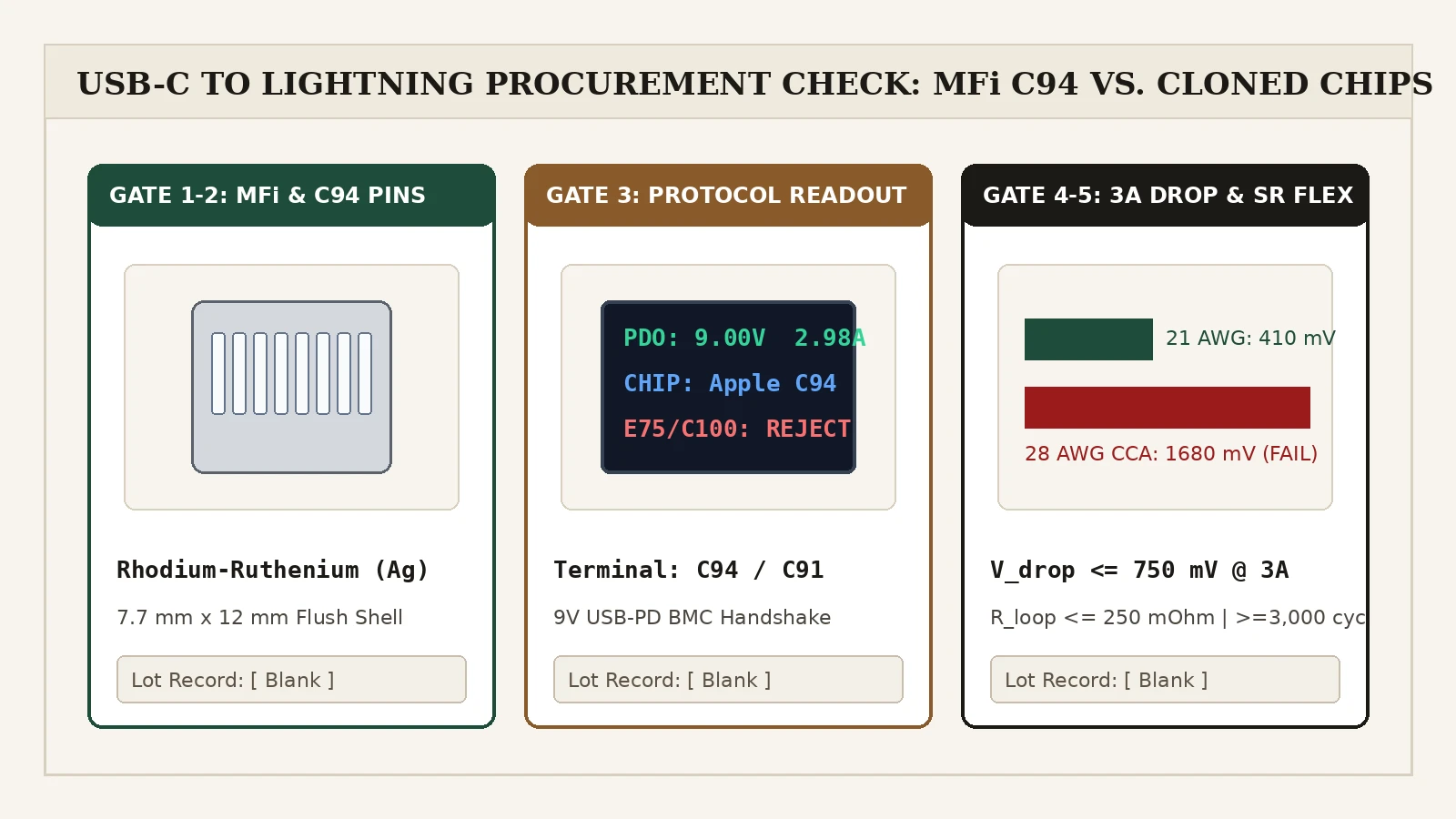
USB-C to Lightning Cable Check: MFi C94 vs. Cloned Chips
Verify a USB-C cable to Lightning before accepting bulk stock: check the MFi database, C94 rhodium-ruthenium pins, PD protocol readouts, 3A IR drop, and SR flex life.
Read article