
Carrier-Unlocked Phones: Band and eSIM Verification
Verify carrier-unlocked phones for bulk buying: distinguish unlock history, check finance and block-list evidence, and match exact-model bands and eSIM.
AI-assisted source check; independent human review not recorded. How this guide was prepared
Carrier-unlocked phones can become failed-activation returns when bands and eSIM verification stop at the seller’s “unlocked” label. Before approving a bulk purchase, establish each handset’s exact model, current carrier-lock status, finance and block-list evidence, and destination carrier’s activation route.
For carrier-unlocked phones, band and eSIM verification must match the exact model code and intended carrier, rather than the marketing name alone. A factory-unlocked claim describes the original sale; a carrier unlock describes a later removal of a restriction. Neither label replaces evidence about the individual handset. This guide separates those checks, uses Apple’s published US iPhone 15 A2846 specifications as a bounded example, and provides a record for deciding which units can proceed and which need to be held.
Quick Specs: what inputs do you need?
Collect the model and intended service before comparing offers. The mobile-phone verification guide explains how to separate model identity, market, condition and seller claims.
Scroll horizontally to see all columns.
| Input or item | Typical value or source | Why it matters |
|---|---|---|
| Exact model and market | Device settings plus the manufacturer’s regional model record | A family name does not identify its radio or SIM configuration |
| Unlock origin | Original purchase evidence or named carrier’s unlock confirmation | Separates initial sales configuration from a later unlock |
| Current lock status | OEM-described setting or original carrier’s confirmation | Shows whether the current restriction has been removed |
| Outstanding finance | Account-holder evidence through the carrier’s process | A block-list result does not establish a paid balance |
| Block-list result and date | Registry service used under its applicable access terms | Status is time dependent and limited to the report’s scope |
| Required network services | Destination carrier, country, plan and required locations | Determines what the published radio specification must be compared against |
| eSIM route | Exact model support plus destination carrier’s provisioning instructions | Hardware support and successful activation are separate findings |
What does factory unlocked prove compared with a carrier unlock?
Treat these as different histories that require different supporting records. For this buying record, factory unlocked means sold initially without a carrier restriction; carrier unlocked means a carrier restriction was subsequently removed. A currently unlocked setting does not reconstruct the original sale.
Google’s Use your Pixel phone with any mobile carrier, read October 19, 2026, states that Google Store phones come unlocked while phones bought elsewhere can be SIM-locked. Apple’s iPhone unlocking guidance assigns an iPhone carrier unlock to the current carrier. These are source-specific pathways, not proof of a reseller’s stock history.
Scroll horizontally to see all columns.
| Offer description | History evidence to request | Current-state evidence still needed | Dominant Failure Mode & Prevention |
|---|---|---|---|
| Factory unlocked | Purchase record identifying the unit and original unlocked configuration | Current lock check, finance/provenance record, registry result and destination acceptance | The label hides a different regional model → match the device code to its OEM specification |
| Carrier unlocked | Original carrier and completed unlock confirmation tied to the unit | Current lock check, separate finance evidence, registry result and destination acceptance | Eligibility or a pending request is mistaken for completion → verify the completed state before release |
| Unlocked, origin unspecified | Seller clarification and available purchase/carrier records | The same current-state checks; leave origin unknown until evidenced | One positive check is substituted for all others → keep each finding in a separate field |
Neither route earns automatic preference. Choose the offer that meets the required service with traceable evidence and a workable remedy. If original unlocked provenance is a contractual requirement, a current unlock alone cannot satisfy it.

How do you verify the exact model and current unlock status?
Read the model from the device and record the unlock finding separately. On an iPhone, Apple’s model-number instructions say the value initially shown beside Model Number in Settings > General > About is the part number; tap it to reveal the model number.
For a Galaxy offer, use the Samsung brand guide to begin model research, then follow Samsung’s identifier guidance. Its Settings > About phone route distinguishes the model identifier from the serial number and IMEI. Keep unit identifiers in the private order record rather than public comparison tables.
For an iPhone’s current lock, Apple’s unlocking article specifies Settings > General > About > Carrier Lock: “No SIM restrictions” indicates unlocked. Save the observation date and connect it to that handset’s private identifier. The setting establishes current carrier-lock status; original sales history and finance need their own evidence. For another device, obtain its manufacturer’s or original carrier’s applicable procedure rather than assuming an identical menu exists.
How do you check unpaid balances and block-list status?
Use the original carrier’s process for finance and unlock eligibility, and the registry’s process for reported block status. Do not ask one result to answer both questions.
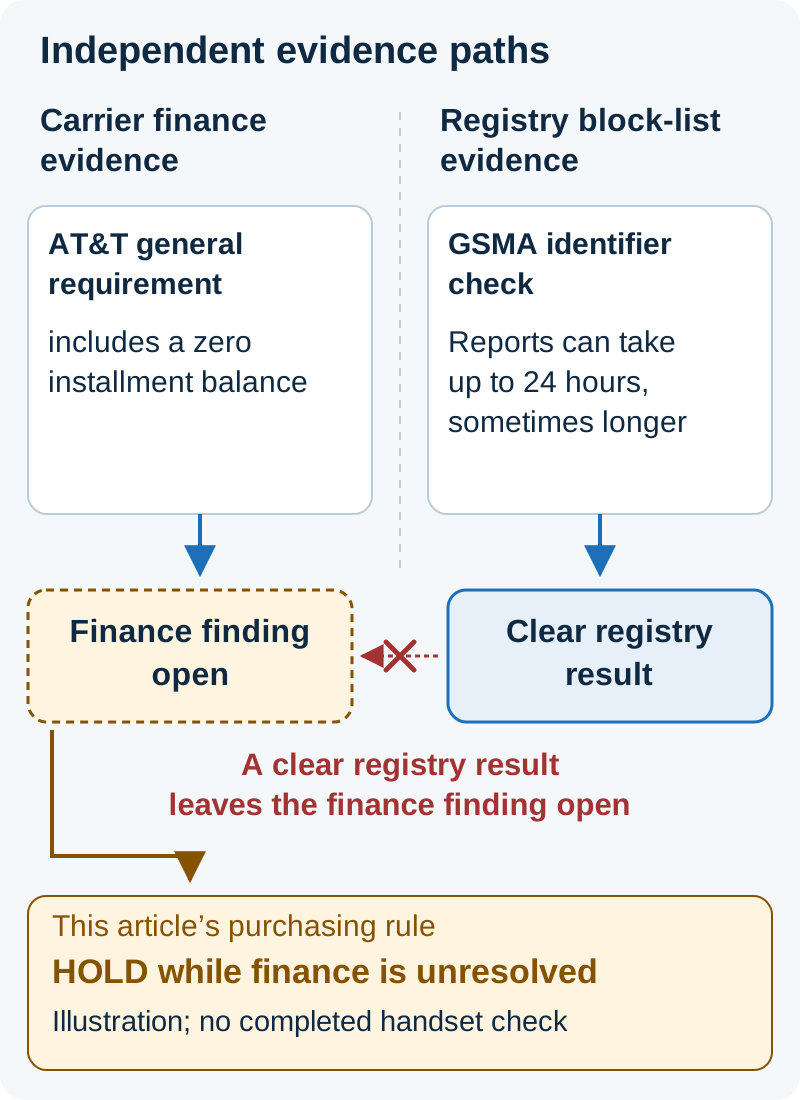
As a concrete program example, AT&T’s Unlock an AT&T device, read October 19, 2026, lists general requirements including purchase more than 60 days earlier, full payment with a zero installment balance, no loss/theft/fraud report, and no activation on another AT&T account; current customers also need an account without overdue bills. The page provides separate prepaid, business and military provisions. Apply the section covering the actual account and device; meeting general criteria is not evidence that an unlock has completed.
Ask the seller or account holder to obtain carrier evidence linking the unit to the payoff and unlock outcome. Redact unrelated account details. If the carrier cannot disclose a balance to a prospective buyer, record it as unresolved and require the account holder to resolve it. A public compatibility lookup should not be described as access to private installment records.
For registry status, the public GSMA Device Check FAQ explains identifier-based checks and the meaning of flagged or currently unflagged results. Use access appropriate to your organization and retain the service, timestamp, identifier and actual result. The FAQ is public guidance; it is not itself a completed check of your handsets.
GSMA’s Terms of Use, under “Basis of GSMA Block List Information,” explain that reports can take up to 24 hours, sometimes longer, to reach the list, and status can change after a check. They also explain that a carrier’s billing block may exist without appearing on the GSMA Block List. Therefore, a clear result is not financial clearance or a promise of future activation. Recheck near shipment and receipt as a purchasing precaution, and agree who handles a later discrepancy; a fixed waiting period cannot eliminate future reports.
Which 5G bands and SIM format does the exact model support?
Compare the actual model’s published radio table with the destination carrier’s requirements; keep LTE and 5G entries separate. Apple’s Identify your iPhone model identifies A2846 as an iPhone 15 variant for the United States and Puerto Rico.
The following entries come from iPhone 15 — Tech Specs, read October 19, 2026, under Cellular and Wireless and SIM Card. They are a selected example for A2846, not the complete band table or a universal list for carrier unlocked phones.
Scroll horizontally to see all columns.
| Published item | A2846 entry or selected entries | Purchase consequence |
|---|---|---|
| Sub-6 5G NR | n5, n41, n71, n77, n78 | Compare the required service with the complete OEM table; this subset does not qualify a network |
| 5G NR mmWave | n258, n260, n261 | A separate radio category; do not substitute it for the required sub-6 service |
| FDD-LTE example | LTE band 13 | An LTE entry does not establish 5G NR support with the same number |
| SIM configuration in this US specification | Dual eSIM, with two active eSIMs; physical SIM cards unsupported | Confirm a usable eSIM provisioning route before approving these units |
Apple directs readers to their carrier for 5G and LTE support details. Obtain the destination carrier’s device-compatibility result and confirmation of the required services; do not infer voice, every 5G mode or usable coverage from band overlap alone. A physical-SIM fallback cannot solve an unresolved eSIM route for this US model.
Use the specification comparison guide to give each regional model its own row, with the OEM source, carrier result and unresolved service requirements alongside it.

What closes eSIM verification before a bulk order?
Close three questions separately: whether the exact variant supports eSIM, whether its current carrier restriction permits the intended provider, and whether that provider can provision the required plan on that handset.
Apple’s Set up eSIM on iPhone, read October 19, 2026, requires a supporting carrier or service provider and describes carrier-dependent activation methods. An eSIM-capable model alone does not select or approve one of those methods for your order.
Google’s Get a SIM or eSIM & add it to your Pixel phone, also read October 19, provides a useful origin-specific exception: Pixel 3a phones bought with Verizon service or in Japan do not work with eSIM. This historical example shows why a family name is insufficient. Google also notes that a carrier may need IMEI 1, IMEI 2 or EID when helping with identification; provide the identifiers it requests through its official process.
Before release, record the intended carrier and plan, its device-check outcome, the supported provisioning method, and the activation evidence required by your purchase terms. For an agreed pilot, have the authorized operator follow the carrier’s instructions, then record calls, messaging and cellular data for the services required by the order. Keep Wi-Fi data from being mistaken for cellular data. A pilot’s result belongs to its identified device and conditions; it cannot certify every unit in a mixed lot.
For a Verizon destination, continue with the device-level Verizon compatibility record for the carrier-specific check.
When should you hold part of the order?
Hold each unit with a failed or unresolved required check. Other handsets’ complete records cannot compensate for its missing evidence.
Rules-of-Thumb: If verified-unit coverage < 100% under an order requiring every handset to meet the named carrier and eSIM requirements → hold the unresolved units because the remaining records do not establish their acceptance. This is an editorial purchasing threshold, not a carrier rule or an industry sampling standard. If the contract requires one complete lot, hold the lot until corrected or renegotiated.
Count distinct handsets, rather than adding issue totals:
R = N − H
Here, R is the number of phones eligible to proceed under the agreed verification policy, N is the number ordered, and H is the number of distinct phones with at least one failed or open required check. This arithmetic applies only when every unit has a recorded disposition; it does not extrapolate a sample to an uninspected shipment.
- Worked example — scenario assumptions: An order contains 100 phones. All required records are complete except for 2 phones with unresolved unlock/finance evidence and 2 different phones with unresolved eSIM acceptance. Thus H = 4 phones, and R = 100 − 4 = 96 phones; verified-unit coverage is 96 ÷ 100 × 100% = 96%. Hold the four and proceed with the 96 only if the contract permits partial acceptance. Count a handset with two open issues once. These inputs illustrate the method; they are not observed defect or return rates.
What belongs in total cost and the final record?
Compare cost per accepted handset after allocating the costs of failed activation and remedy. A lower quoted unit cost can be outweighed by verification work, return freight and repacking time; use the total-cost guide to keep offers on the same basis.
A practical TCO ledger includes acquisition, verification labor, outbound and return freight, repacking materials and time, activation charges that cannot be recovered, and repair or replacement exposure where the expected warranty route is unavailable. Subtract actual refunds or credits. Keep cost categories separate so that a failed-activation return is not counted twice as both a full loss and a reimbursed replacement. Use documented transaction inputs rather than an assumed return rate or warranty entitlement.
Download the blank carrier-unlocked phone verification record. The CSV contains headers only: add one row per handset using the evidence collected for your order. Keep identifiers and account evidence in your private order file.
Keep this private record for each handset:
- Lot reference, exact model, stated market and unit identifiers.
- Original unlocked-sale or carrier-unlock evidence, current lock observation and date; unresolved history explicitly marked.
- Finance evidence, responsible account holder and carrier outcome.
- Registry service, actual result and check timestamp, with receipt recheck assigned.
- Destination carrier/plan, required services, OEM band source and device-acceptance result.
- eSIM provisioning method and the activation evidence required or completed, including its scope.
- Hold/release decision, reporting window, remedy provider, freight allocation and warranty route.
Use the first-order risk checklist to assign shipment, receipt and exception owners. Keep the model comparison separate from the private identifier file, and retain both with the order. Other purchasing checks are available in the articles directory.
Method and sources
This guide combines public OEM specifications and support instructions with AT&T’s published unlock conditions and GSMA’s public registry guidance, checked October 19, 2026. Source titles, program scope and links accompany the relevant claims. The A2846 table selects entries from Apple’s US specification; it does not establish carrier acceptance for a particular handset.
The evidence matrix, purchasing threshold, record fields and hypothetical release calculation organize these verification steps into one order workflow. Actual payoff, registry queries, activation results and warranty eligibility remain transaction-specific evidence to collect. See the editorial methodology for source and correction practices.
Updated October 19, 2026.
Sources checked
Related articles
NDAA Compliant Security Cameras: What to Read on the Spec Sheet
Verify NDAA compliant security cameras before ordering: check FAR 52.204-25 covered entities, HiSilicon SoCs, 47 CFR 2.933 FCC ID grants, and ONVIF fields.
Read article
Check IMEI Number: What a Wholesale Lot Check Does Not Prove
Check IMEI numbers before accepting a wholesale phone lot. Separate blacklist results from finance, activation locks, repair history and carton coverage.
Read article
Authorized Distributors vs. Component Brokers: ECIA, CoC & IC Lab Tests
Compare franchised distributors (Mouser Electronics, DigiKey, Arrow) with open-market brokers to prevent counterfeit IC failures: verify SAE AS6496 CoC, MSL 3, and AS6171.
Read article